A family name can point toward Croatia, but a document can take you to the exact village, parish, and house where your family story began. For travelers asking what documents prove Croatian heritage, the answer is rarely a single certificate. It is usually a carefully connected chain of records that links you, generation by generation, to an ancestor born in Croatia or in a historic Croatian community.
That distinction matters. Heritage proof may be enough to guide a meaningful ancestral journey, while a citizenship application can require a much more formal, certified set of records. Whether your goal is to understand your roots, visit an ancestral village, or explore eligibility for Croatian citizenship, the most valuable first step is the same: establish the paper trail before you travel.
What Documents Prove Croatian Heritage?
The strongest evidence is a sequence of official records that shows direct descent. In practical terms, that means beginning with your own birth certificate and working backward through a parent, grandparent, or great-grandparent to the Croatian-born ancestor.
For most families, the core record set includes civil birth, marriage, and death certificates. A birth certificate establishes parentage. A marriage certificate can connect a woman’s maiden name to her married name and identify parents or a place of birth. A death certificate may provide an ancestor’s birthplace, though those details should be treated as clues rather than final proof because informants were not always accurate.
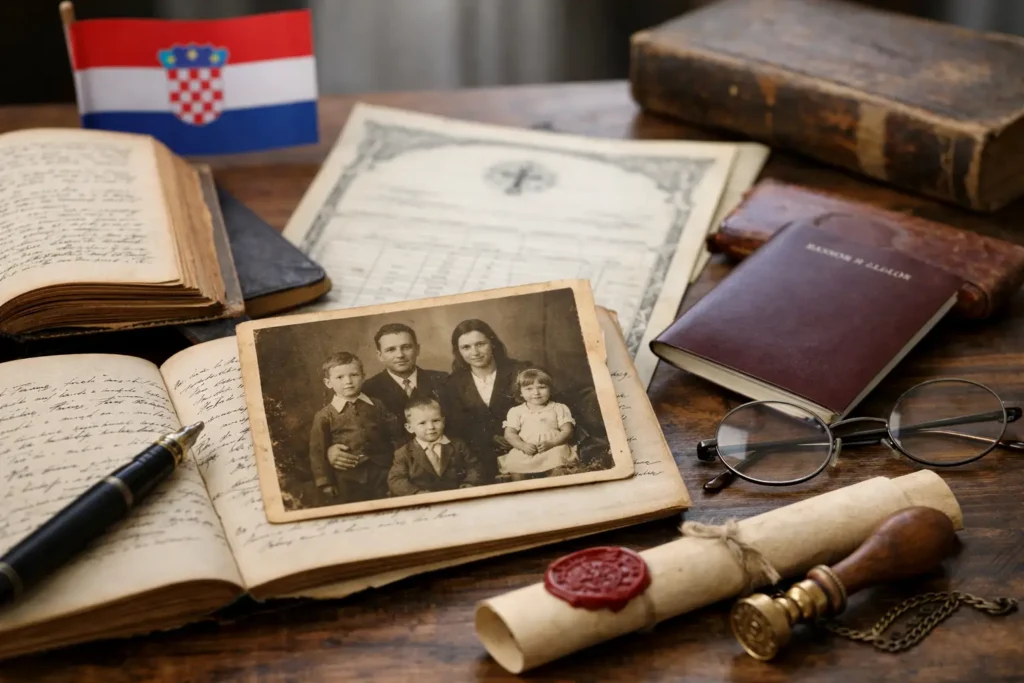
The essential documents often include:
- Your long-form birth certificate, showing your parents’ full names
- Birth, marriage, and death certificates for each generation between you and the Croatian ancestor
- The Croatian ancestor’s birth or baptismal record
- Naturalization, immigration, passport, or alien registration records, where available
- Name-change, adoption, divorce, or court records when a family line changed names or legal identities
The goal is not simply to gather old papers. It is to make each document answer one question: who were this person’s parents, and where did this person belong in the family line?
Civil Records: The Foundation of a Clear Family Line
Civil records are typically the most persuasive starting point because they were created by government authorities. In Croatia, civil registration records are known as matice, with separate registers for births, marriages, and deaths. Depending on the year and locality, these records may be held by a local registry office, a regional archive, or another official authority.
For heritage purposes, an ancestor’s Croatian birth record is especially powerful. It may identify the municipality, settlement, parents, and sometimes a house number. That house number can become remarkably meaningful when you later stand in the village and see how close the parish church, family fields, harbor, or town square were to your ancestor’s daily life.
American records matter just as much. An ancestor may have identified their birthplace as Austria, Hungary, Yugoslavia, Italy, or simply Dalmatia rather than Croatia. These descriptions reflect shifting borders and the political geography of the time, not necessarily a different family origin. A birth village that is in Croatia today may have been recorded under another empire or state when your ancestor left Europe.
When requesting certificates in the United States, obtain certified long-form copies whenever possible. Short-form certificates and family-tree printouts may be helpful references, but they do not always contain the parentage or official authentication required for legal processes.
Why One Record Is Rarely Enough
A death certificate that says “Croatia” does not by itself prove Croatian heritage. It may be incomplete, misspelled, or based on a relative’s best recollection. Likewise, a passenger list can be compelling but may identify only a broad region.
What creates confidence is corroboration. A passenger manifest naming a hometown, an American marriage certificate listing the same parents, and a Croatian baptismal record with matching names and dates form a far more convincing story than any one document alone.
Parish Registers Can Take You Further Back
Before civil registration became widespread, parish registers were often the primary record of family life. Catholic parish books are particularly important in much of Croatia and may include baptisms, marriages, deaths, confirmations, and household information. Orthodox, Protestant, Jewish, and other religious community records can be equally significant, depending on your family’s background and region.
A baptismal entry may reveal more than a birth date. It can name parents, godparents, a village, and occasionally social or occupational details. Godparents are not legal proof of descent, but they can reveal the close network of families surrounding your ancestors. For travelers, these connections can add depth to a village visit, especially when several surnames appear repeatedly in the same parish.
Parish books demand patience. Records may be written in Latin, Italian, German, Hungarian, Church Slavonic, or older Croatian forms. Handwriting can be difficult, dates may follow different conventions, and surnames often appear in several spellings. A name you know as Kovac in America may appear as Kovač, Kovach, or another variant in historical records.
Do not discard a record simply because the spelling differs. Compare parents’ names, ages, occupations, villages, and house numbers. In genealogy, the surrounding details are often more reliable than a single letter in a surname.
Immigration and Naturalization Records Add Context
Immigration records help explain when and how a Croatian ancestor became part of your American family story. Passenger lists may name a last residence, nearest relative in the old country, intended destination, or person waiting in the United States. Those details can lead directly to a village or identify relatives who remained in Croatia.
Naturalization records can be especially useful because they sometimes record an exact date and place of birth, former nationality, arrival information, and name changes. Earlier records can be sparse, while later petitions may be exceptionally detailed. A declaration of intention, petition for naturalization, and certificate of naturalization may each contain different clues.
Military draft cards, census returns, obituaries, cemetery records, and fraternal society documents are supporting evidence rather than primary proof. Still, they can solve difficult puzzles. An obituary that names a hometown, for example, may distinguish between two men with the same name who immigrated around the same year.
If Croatian Citizenship Is Part of Your Story
Heritage travel and citizenship are related, but they are not the same undertaking. If you are exploring citizenship by descent, expect stricter standards. Authorities may require official or certified copies, complete proof of the direct line, translations, and additional authentication for foreign-issued documents. Eligibility can also depend on when your ancestor emigrated, whether citizenship was retained or lost, and the laws that applied to each generation.
This is where families often discover an inconvenient but manageable gap. A great-grandmother may be known by a married name in the United States but by a maiden name in Croatian records. An ancestor may have changed a surname after arrival. A birth date may vary by a year or two across documents. These discrepancies do not automatically end the process, but they should be addressed methodically rather than explained away.
For a legal application, consult a qualified citizenship or legal professional familiar with Croatian requirements. For a roots journey, the same research can still be transformative, even if the formal citizenship path is uncertain.
Preparing Your Documents for an Ancestral Visit
Create a simple family file before planning your itinerary. Keep a digital copy of every record, note where it came from, and record alternative spellings of names and places. Make a one-page family timeline with births, marriages, migrations, and the last known Croatian location for each direct ancestor.
The most helpful discovery is usually not just “Croatia,” but a precise place: a village near Šibenik, an island parish off the Dalmatian coast, a neighborhood in Split, or a family home in inland Istria. That specificity makes it possible to shape a journey around your story rather than follow a generic route.
A well-designed heritage itinerary can pair an ancestral village visit with the pleasures that make time in Croatia feel restorative: a private guide who understands the region, lunch at a family-run konoba, an unhurried afternoon on the water, and evenings in distinctive hotels or aboard a private yacht. At Adriatic Roots Cruises, those details can be arranged around the research, so family history remains the heart of the experience rather than a brief stop between tourist sites.
When the Paper Trail Stops
Not every family will find a perfect set of documents. Wars, changing borders, fires, emigration, and inconsistent recordkeeping have left real gaps in many Croatian family histories. Sometimes the answer lies in a sibling’s record, a godparent’s name, a probate file, or an oral history preserved by an older relative.
If you reach a dead end, do not assume the story is over. Gather family photographs, letters, prayer cards, funeral notices, old passports, and the names of relatives who may have stayed behind. Even a faded return address or the name of a parish saint can offer a direction for further research.
The documents prove a lineage, but they also do something more personal: they give shape to a family story that may have crossed an ocean in fragments. When you arrive with those fragments in hand, Croatia is no longer just a destination. It becomes a place where your own history has a name, a landscape, and a way home.