
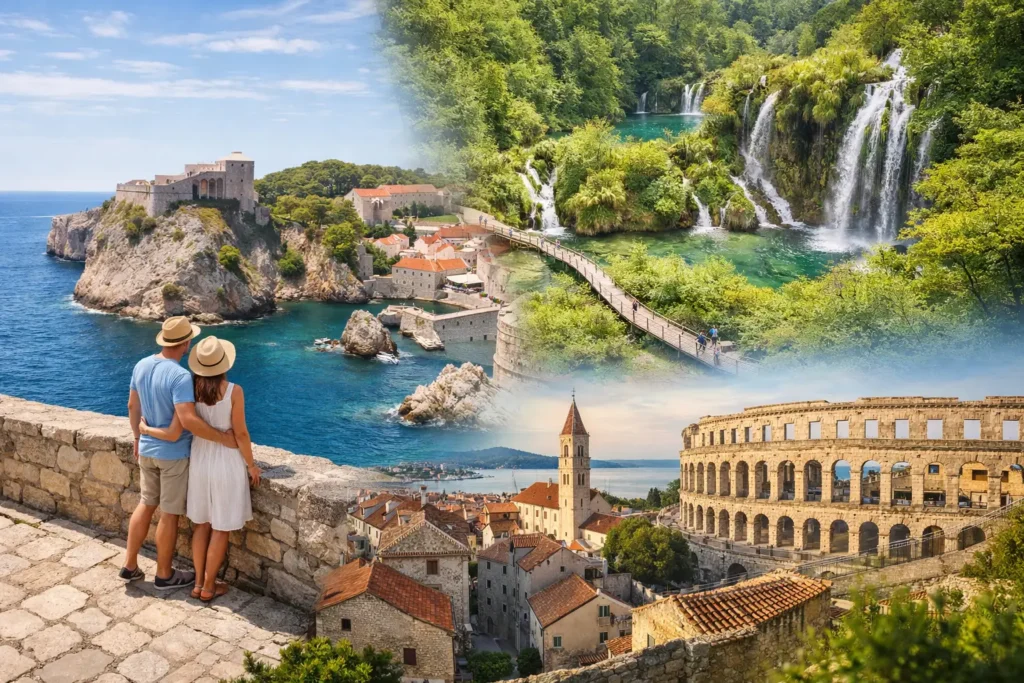
A private tender slips into Dubrovnik’s old harbor before the city’s marble lanes fill with day visitors. Later, perhaps, your family gathers over a long lunch on Pelješac, looking back toward the walls that guarded the Republic of Ragusa for centuries. These are the top Croatian UNESCO experiences at their most rewarding: not hurried checkmarks, but deeply felt encounters with the places that shaped the Adriatic and, for many travelers, their own family story.
Croatia’s UNESCO sites are remarkably varied. A Roman emperor’s retirement palace became the living heart of Split. A medieval field on Hvar still follows its ancient Greek grid. A cathedral in Šibenik reveals what local stone masters could achieve without relying on imported ornament. The right journey gives each place room to speak, with the comfort, privacy, and context that turn a beautiful visit into a lasting memory.
The Top Croatian UNESCO Experiences by Sea and Shore
Walk Dubrovnik before the crowds arrive
The Old City of Dubrovnik is one of the Adriatic’s great visual moments, but timing changes everything. From a private yacht or boutique vessel anchored nearby, an early entrance allows you to walk the limestone streets while shutters are still opening and the scent of coffee begins to drift from small cafés.
A knowledgeable private guide can move beyond the familiar viewpoints to reveal the city’s mercantile history, its diplomatic ingenuity, and the family names that once passed through its gates. For travelers tracing Dalmatian roots, archival preparation may add another layer: a parish, a surname, a former neighborhood, or a port record that makes the walled city feel less like a monument and more like part of your inheritance.
Dubrovnik deserves its acclaim, but it also receives the greatest volume of visitors. Staying on the water nearby, arriving early, and pairing the city with quieter Konavle villages or the Elaphiti Islands creates a more graceful rhythm.
Feel Roman life beneath Split’s modern pulse
Diocletian’s Palace is not a preserved ruin set apart from the city. It is the city. Residents live within its old walls, cafés occupy former chambers, and laundry may hang above passages once used by imperial servants. That continuity is precisely what makes Split so compelling.
A private walking experience can trace the transition from Roman palace to medieval town and lively modern port, including the Peristyle, subterranean halls, and smaller corners often missed on broad group tours. For a multigenerational family, Split is especially easy to enjoy: there is history in every direction, yet the pace can remain relaxed, with shaded pauses and a waterfront lunch overlooking your vessel.
Split also works beautifully as a gateway. It connects naturally to Brač, Hvar, Vis, and the Makarska coast, allowing a land-and-sea itinerary to combine one of Croatia’s most significant UNESCO sites with the islands where family memories and regional traditions often run deepest.
Let Trogir reveal its quieter grandeur
Just west of Split, Trogir offers a different scale of beauty. Its compact historic center sits on a small island, shaped by Greek, Romanesque, Gothic, Renaissance, and Venetian influences. The Cathedral of St. Lawrence and its extraordinary Radovan Portal reward a patient visit, especially with a guide who can explain the human stories carved into the stone.
Trogir is an ideal counterpoint to Split because it feels intimate rather than monumental. Arrive by private car or tender in the late afternoon, when the light softens across the waterfront and many day visitors have moved on. A lingering dinner overlooking the marina gives the experience the unhurried quality this town deserves.
See Šibenik through the hands of its builders
Šibenik is one of the Adriatic’s most satisfying cultural stops because its UNESCO heritage tells a story of local invention. The Cathedral of St. James was built almost entirely from stone, assembled with an ingenious technique that required exceptional skill. Its exterior frieze of sculpted heads remains wonderfully personal, a gallery of faces from a distant but recognizable world.
The city also connects to the Venetian Works of Defense, represented by the Fortress of St. Nicholas at the entrance to St. Anthony’s Channel. Approaching by boat is the right way to understand it. The fortress was designed to control the sea passage, and the water still provides the most dramatic perspective.
A private cruise makes it possible to experience both sites without forcing the day into a rigid schedule. You might visit the cathedral in the morning, retreat to the yacht for lunch, then return by tender toward sunset for the fortress and a glass of Croatian wine on deck.
Read an ancient landscape in Stari Grad Plain
On Hvar, the Stari Grad Plain offers a quieter kind of UNESCO encounter. Its geometry dates to Greek colonists in the 4th century BCE, and the patchwork of stone walls, vineyards, olive groves, and small agricultural plots still reflects that ancient plan. This is not heritage behind velvet ropes. It is a working landscape.
The best way to experience it is slowly, with a local guide, grower, or historian who understands the families connected to the land. A private tasting at a small winery or olive estate can give form to what might otherwise seem like a beautiful rural drive. For those with island ancestry, this is often where a journey becomes unexpectedly emotional: a surname, a chapel, or an old family field can bring generations together in a single afternoon.
Make room for Plitvice Lakes
Plitvice Lakes National Park is Croatia’s great inland contrast to the coast. A series of turquoise lakes and travertine waterfalls, joined by pathways and wooden walkways, it offers a landscape shaped by living water rather than stone architecture.
It requires thoughtful planning. Plitvice is best visited with an early start, a private naturalist guide, and enough time to follow a route suited to your fitness level. It is not the place to squeeze between a morning transfer and an evening embarkation. The park is a meaningful addition for travelers who want to see Croatia beyond the shoreline, particularly when paired with Zagreb, Istria, or a custom overland route before joining a ship in Dalmatia.
Find Poreč’s Byzantine brilliance
The Euphrasian Basilica in Poreč is among Istria’s most remarkable cultural treasures. Its 6th-century mosaics glow with gold and deep color, offering a rare sense of the Byzantine world on the northern Adriatic. The surrounding episcopal complex adds depth, revealing how faith, civic life, and artistic patronage were entwined in this coastal town.
Poreč suits travelers who prefer a more understated luxury experience. Combine the basilica with an elegant Istrian lunch, local olive oil, and time in nearby hill towns, where Venetian history and Croatian traditions meet. It is a particularly appealing choice for couples or families extending their journey toward Slovenia.
Heritage Beyond the Famous Landmarks
Croatia’s newer and less familiar UNESCO entries can be the most resonant for heritage-minded travelers. The medieval stećci tombstones found in sites such as Cista Velika speak to the shared cultural landscape of the western Balkans. Their carved symbols, rosettes, figures, and inscriptions invite reflection rather than easy answers.
The ancient and primeval beech forests of Paklenica and Northern Velebit offer another perspective entirely. These protected forests are not designed for conventional sightseeing. They are for travelers who value wild beauty, private hiking, and the feeling of stepping away from the coast’s polished social rhythm for a few hours or a day.
Neither experience is essential for every itinerary. A first visit focused on Dubrovnik, Split, Hvar, and Šibenik may be more satisfying than trying to reach every designation. But for returning travelers, or for those whose roots lead inland, these places add a richer understanding of Croatia’s cultural and natural depth.
How to Design a UNESCO Journey Around Your Story
The most memorable UNESCO itineraries are built around connections, not a list. A family with roots near Split may begin among archival records and ancestral villages, then continue by yacht to Trogir, Šibenik, and Hvar. A couple drawn to art, food, and Roman history may combine Poreč with Istria’s vineyards before heading south to Diocletian’s Palace. A multigenerational group might choose a gentler Adriatic route, balancing short private tours with long lunches, swimming coves, and time together on board.
The practical details matter. Private guides can adapt the pace when children are tired or a conversation at a village church becomes unexpectedly meaningful. A yacht gives you a serene base rather than a daily packing routine. Reservations, transfers, museum timing, and access to local hosts are coordinated around your preferences, while still leaving space for the lovely surprises that cannot be scheduled.
At Adriatic Roots Cruises, that is the distinction: a UNESCO site is never treated as an isolated attraction. It becomes part of a journey designed around your family, your interests, and the places that call you back.
When you picture Croatia, do not begin with how many landmarks you can see. Begin with the story you hope to carry home, then give that story the time, comfort, and attention it deserves.