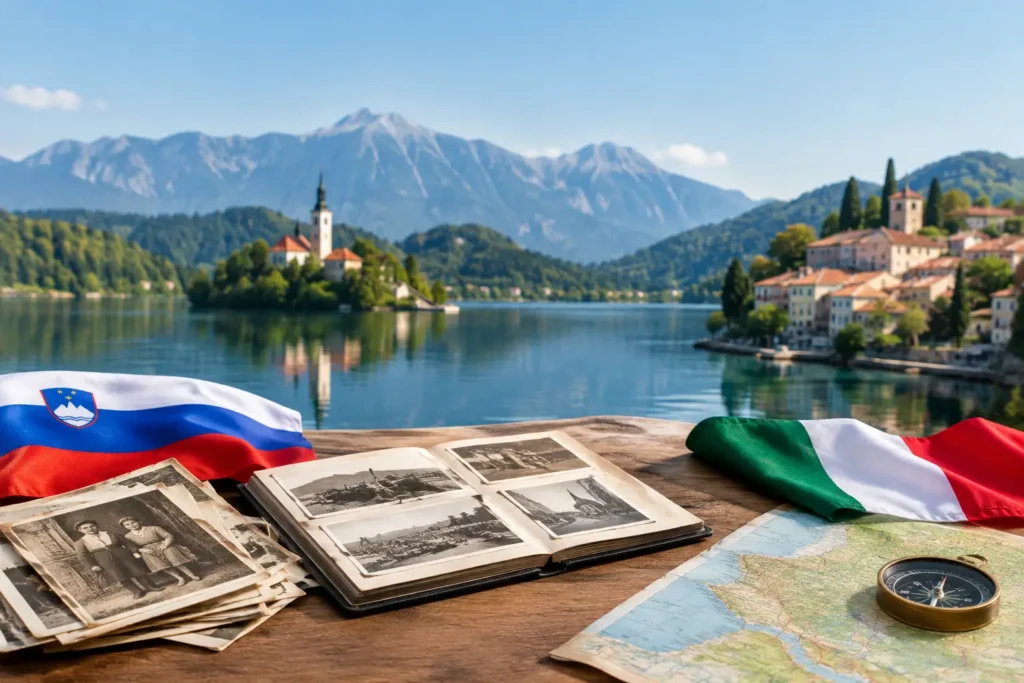
For families tracing Slovenia Italy ancestry, a surname rarely tells the whole story. The same grandparents may have called themselves Slovenian at home, used Italian in official documents, attended a Latin-language parish, and lived in a town whose national border changed more than once during their lifetime. This is not a contradiction. It is the texture of a borderland history – and the reason a return journey can feel so personal.
The most meaningful heritage travel begins by treating the Italy-Slovenia border not as a line on a modern map, but as a living cultural landscape. Your family story may lead from the Karst plateau to Trieste, from Gorizia to Nova Gorica, or from a coastal village near Piran to a parish archive across the border. With thoughtful planning, those places become more than stops on an itinerary. They become a setting for understanding where your family came from, how they moved through the world, and what they carried with them.
Why Slovenia Italy Ancestry Can Be Complex
The northeastern Adriatic has long been a meeting place of Slavic, Italian, Germanic, Jewish, and Friulian cultures. For centuries, much of present-day Slovenia was within the Habsburg Empire, while nearby coastal communities were shaped by Venetian influence and later Italian administration. After World War I, new borders placed many Slovene-speaking communities under Italy. After World War II, borders shifted again.
That history has practical consequences for family research. A birthplace recorded as Austria in a US immigration document may now be in Slovenia. A relative who identified their hometown as Italy may have been born in a village that is now across the border. Place names often appear in Slovenian, Italian, German, or older local forms, sometimes with different spellings in the same family’s papers.
Trieste is a particularly frequent point of connection. The city was the Habsburg Empire’s great Adriatic port, a departure point for emigrants and a crossroads for families from the Karst, Istria, Gorizia, and inland Slovenia. Yet not every record naming Trieste means an ancestor lived in the city itself. It may indicate the broader province, the port of departure, or the nearest recognizable administrative center.
The key is to resist forcing a modern identity onto an older record. Your ancestor’s language, citizenship, religion, and sense of belonging may not fit neatly into one present-day category. That complexity is often where the most moving discoveries begin.
Begin With the Village, Not the Country
“Slovenia” or “Italy” is usually too broad to guide a roots journey. The breakthrough comes from identifying the specific village, parish, municipality, or district connected to your family.
Start with the documents already in your home: naturalization papers, passenger lists, marriage certificates, funeral cards, family Bibles, old letters, and the backs of photographs. Pay close attention to witnesses and godparents, who were often relatives or neighbors from the same village. A small clue – an altered spelling, a saint’s day, a handwritten return address – can narrow a search significantly.
Once a locality emerges, compare its historical names and jurisdictions. A town near today’s Italian-Slovenian border may have been recorded under the Austrian crown land of Carniola, the Austrian Littoral, Gorizia and Gradisca, Venezia Giulia, or Italy, depending on the year. Families from Istria require additional care because their story may now extend across Slovenia, Croatia, and Italy.
This is also where professional genealogy support can make a difference. The goal is not merely to build a chart of names and dates. It is to establish enough confidence that a visit to a parish church, cemetery, ancestral lane, or municipal office feels grounded in your family’s actual history.
Records That Often Hold the Strongest Clues
Church registers can be especially valuable for Catholic families, preserving baptisms, marriages, and burials across generations. Depending on the place and period, entries may be written in Latin, Italian, Slovenian, or German. Civil registration records, cadastral maps, military records, and household registers can add occupation, house numbers, landholdings, and migration patterns to the picture.
Availability varies. Some records have been digitized, while others remain in diocesan, municipal, or regional archives. Privacy rules may limit access to more recent documents, and a family name alone is rarely enough to confirm a connection. That is why careful pre-trip research matters: it allows time to request appointments, identify relevant archives, and build an itinerary around places that are genuinely meaningful.
Turn Research Into a Journey You Can Feel
A heritage itinerary should leave room for discovery without becoming a research marathon. The right balance pairs private historical exploration with the comforts that make time together enjoyable – considered hotels, beautiful meals, unhurried drives, and guides who understand the local context.
Imagine beginning in Trieste, where coffeehouses, Austro-Hungarian architecture, and the Adriatic waterfront offer an evocative introduction to the region. From there, a private guide can lead you into the Karst, where stone villages, vineyards, and family cemeteries often reveal the quieter world behind an immigration record. You might visit a parish connected to a baptismal entry, pause at a house number found in an old register, or simply walk the lanes your ancestors would have known.
Across the border, Ljubljana offers a graceful base for understanding Slovenia’s distinct cultural identity, while the coast around Piran provides a softer Adriatic rhythm. For families with roots near Gorizia, a day shared between Italian Gorizia and Slovenian Nova Gorica makes the border’s history tangible. The two towns are neighbors now, but their twentieth-century story explains why one family’s documents may point in several directions.
For those drawn to the sea, a private Adriatic cruise can create an elegant connective thread between land-based discoveries. A yacht or boutique vessel offers privacy for a multigenerational family, freedom to set your own pace, and a restorative contrast to emotionally charged ancestral visits. After a morning in a village archive or cemetery, there is real value in gathering over lunch on deck, watching the coastline recede, and sharing the stories that surfaced.
Let the Family Set the Pace
Not every heritage trip needs to include an archive appointment or a meeting with distant relatives. Some travelers want to stand in an ancestral village and absorb its atmosphere. Others hope to trace several generations, visit multiple parishes, or connect with living family members. Both approaches are valid, and they call for different planning.
When living relatives are involved, discretion matters. A local introduction should be thoughtful, never assumed. People may be delighted to meet American cousins, but they may also have limited information, different memories, or understandable reservations about a first encounter. The most respectful journeys allow space for a meeting to develop naturally rather than treating it as a guaranteed itinerary feature.
Multigenerational families also benefit from a layered experience. Grandparents may value church records and oral history, while younger travelers respond to food, coastal landscapes, and the realization that a familiar family recipe has roots in a particular valley or town. A private guide can make history accessible without reducing it to a lecture.
Questions Worth Answering Before You Go
Before setting dates, clarify what would make the journey feel successful. Is your priority confirming a birthplace, honoring a grandparent, meeting relatives, or giving children a richer sense of their heritage? Are you comfortable with the possibility that records may be incomplete or that a long-held family story may need revision?
It also helps to decide how much time belongs to ancestry and how much belongs to leisure. A two-week journey may allow for research appointments in Trieste or Gorizia, village visits in Slovenia, and several restorative days on the Adriatic. A shorter stay may be better focused on one ancestral area rather than trying to cover both countries broadly.
The finest roots journeys do not rush toward a tidy answer. They make room for the details that endure: a church bell in a hillside village, a family name on weathered stone, a local dish that tastes unexpectedly familiar, and the quiet recognition that your story was shaped by this place. Adriatic Roots Cruises designs that kind of experience around your family, so the journey home feels as personal as the history that inspired it.