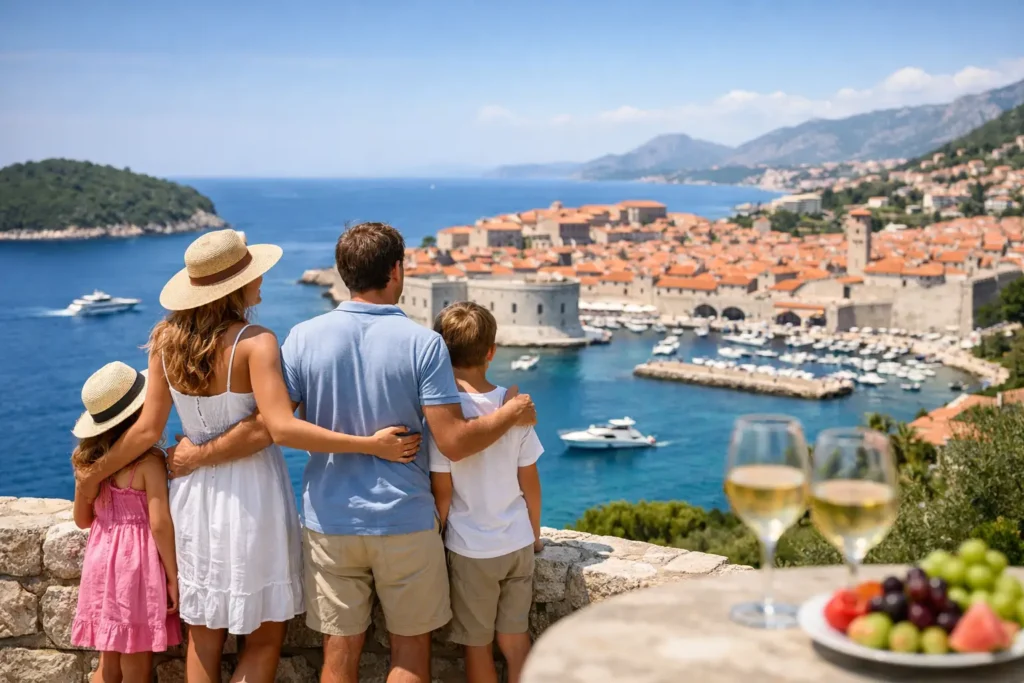
A family lunch beneath a stone village bell tower can stay with you longer than any photograph of the coast. So can hearing an elder pronounce a family surname the way your grandparents once did, or watching your children swim in the clear water below an island your family may have left generations ago. A luxury Croatia family trip guide should begin there: not with a checklist of ports, but with the people, places, and memories you want to bring closer.
Croatia rewards travelers who give it time. Its islands, walled towns, vineyards, and inland villages are close on a map but deeply distinct in character. For families traveling together, the most satisfying experience balances beautiful surroundings with room to rest, explore, and be present with one another. Add a personal connection to the region, and the itinerary becomes more than a vacation. It becomes part of your family story.
Luxury Croatia Family Trip Guide: Start With Your Story
The first question is not whether to begin in Dubrovnik or Split. It is what you hope this trip will mean. A multigenerational family celebrating an anniversary may want long, unhurried lunches, a private yacht, and a handful of thoughtfully chosen cultural moments. A family with Croatian roots may place an ancestral village, parish church, cemetery, or regional archive at the center of the journey. Families with younger children often need a different rhythm: shorter drives, flexible meal times, swimming stops, and activities that feel like discovery rather than instruction.
These priorities shape every good decision that follows. They determine how many nights to spend in each place, whether a private vessel or boutique ship is the better fit, and where privacy matters more than proximity to nightlife. They also help avoid a common mistake: trying to see the entire coast in one week. Croatia is best experienced in chapters.
For many families, a seven- to ten-night itinerary works well when focused on one stretch of the Adriatic, such as Split, the Dalmatian islands, and Dubrovnik. Ten to fourteen nights create space to pair the coast with Zagreb, Istria, Slovenia, or an ancestral region farther inland. There is no universal ideal length. The right pace depends on your ages, interests, and how much of the journey is dedicated to heritage research.
Choose a Style of Travel That Keeps Everyone Comfortable
A private yacht offers the greatest freedom for a family group. You can set a gentler morning pace, swim before lunch, change course for a quieter cove, and arrange excursions around your own schedule. It is especially well suited to travelers who value discretion and would rather return each evening to a familiar, beautifully appointed space than change hotels repeatedly.
A boutique small ship can be an excellent alternative when you enjoy the ease of cruising but do not require full vessel exclusivity. The trade-off is less control over timing and route. For some families, that structure is welcome. For others, particularly those coordinating private heritage visits or traveling with several generations, flexibility is worth the investment.
Land stays bring a different kind of intimacy. A historic villa near Split, a refined waterfront hotel in Hvar, or a secluded Istrian estate can give a family time to settle in. This approach works particularly well when your plans include villages or towns that are not accessible by sea. Many of the most meaningful ancestral places sit above the coast, reached by winding roads through olive groves, limestone hills, and small communities where local knowledge makes all the difference.
The most rewarding journeys often combine both. A few nights on land can provide context and restorative comfort before a private cruise carries the family between islands. You gain the pleasure of arriving by water while keeping enough time for the places that ask you to slow down.
Build an Itinerary Around Moments, Not Just Destinations
Dubrovnik, Hvar, Korčula, Vis, Split, and the Pakleni Islands are rightly celebrated, but their value lies in how you experience them. A private early-morning walk through Dubrovnik’s old city feels entirely different from entering with the midday crowds. In Split, a knowledgeable guide can reveal how daily life still unfolds within Diocletian’s Palace, rather than simply pointing out its Roman stones.
For a family itinerary, each destination should have a purpose. Hvar might be for a relaxed afternoon at sea and dinner in a garden restaurant. Korčula may offer a private tasting with a small producer, followed by a visit to a family-run konoba where the recipes have been passed down for generations. Vis could be the quiet counterpoint, with a blue-water swim and a slower island lunch.
Leave open time between these experiences. Children need room to play. Teenagers need a little independence. Adults need the freedom to linger over coffee or choose an afternoon nap without feeling they are missing a scheduled sight. Luxury is not constant activity. It is having the right things arranged, then having the space to enjoy them.
Make Heritage Part of the Journey, Not an Add-On
For travelers with roots in Croatia, Slovenia, or the wider Dalmatian cultural sphere, genealogy and heritage planning should begin well before departure. A family name can point in several directions, and historical borders, language variations, and migration records can make assumptions unreliable. The research may uncover a precise village, a parish register, an old home site, or simply the region where your family story began.
Even when records are incomplete, a heritage day can be deeply moving. Imagine arriving at a hillside village with a local guide who understands its history, meeting a resident who recognizes your family name, or sitting in a church where earlier generations marked baptisms and marriages. These moments deserve time and sensitivity. They should never be treated as a hurried stop between more conventional attractions.
When younger family members are traveling, heritage experiences become more engaging when connected to lived details. Rather than presenting dates alone, share the story of what a great-grandparent may have eaten, cultivated, carried, or left behind. A meal prepared with regional ingredients, a walk through old terraces, or a conversation with a local craftsperson can make family history tangible.
Plan for the Season You Actually Want
July and August deliver long, bright days and the full energy of the Adriatic summer. They are ideal for families who want warm sea temperatures, lively waterfront evenings, and dependable beach weather. They also bring the highest demand, busier marinas, and more visitors in headline destinations. Privacy is still possible, but it requires careful planning and the willingness to choose quieter islands, lesser-known coves, and well-timed excursions.
Late May, June, September, and early October are often the most elegant months for a luxury family journey. The water is inviting, the light is beautiful, and restaurants and cultural sites feel less pressured. September is particularly appealing for multigenerational groups: the summer intensity softens, yet the coast remains wonderfully alive.
Spring and fall can also be better for land-based heritage exploration. Village visits, inland drives, and city walks are more comfortable without peak summer heat. If swimming is central to the trip, however, June through September remains the safest choice.
The Details That Change a Good Trip Into a Personal One
The most useful luxury planning happens quietly in the background. It means knowing which family member needs a ground-floor room, which child has a favorite meal, and which grandparent would prefer a shaded car transfer rather than a steep walk through an old town. It means arranging a trusted guide who can adjust the day without making the adjustment feel like a compromise.
Dining deserves the same care. Croatia offers extraordinary seafood, olive oil, wine, truffles, lamb, and regional cooking, but the best meal for your family may not be the most formal one. A private chef dinner aboard your yacht can be ideal after a day in the sun. On another night, a small family restaurant with outdoor tables and local music may create the story everyone remembers. Dietary needs and young travelers’ preferences should be handled in advance, so meals remain pleasurable rather than logistical.
It is also wise to protect a few unscripted evenings. A waterfront promenade, gelato after dinner, or a spontaneous swim at sunset can become the moment that binds the trip together. A carefully designed itinerary should feel considered, never overmanaged.
Give Each Generation Something to Take Home
The best family travel does not demand that everyone enjoy the same thing in the same way. A grandparent may cherish the return to an ancestral region. Parents may value the rare ease of having every transfer and reservation thoughtfully handled. Children may remember jumping from the back of a boat into a quiet bay. Teenagers may leave with a stronger sense of where they come from than they expected.
At Adriatic Roots Cruises, every itinerary is shaped around that balance of comfort, discovery, and connection. The aim is not to fill a calendar. It is to create the conditions for your family to feel at home in a place that may be new to some of you, and profoundly familiar to others.
Begin with the names, photographs, stories, and questions your family already holds. Croatia will offer the setting, but the most meaningful moments will come from giving those stories the time and care they deserve.