
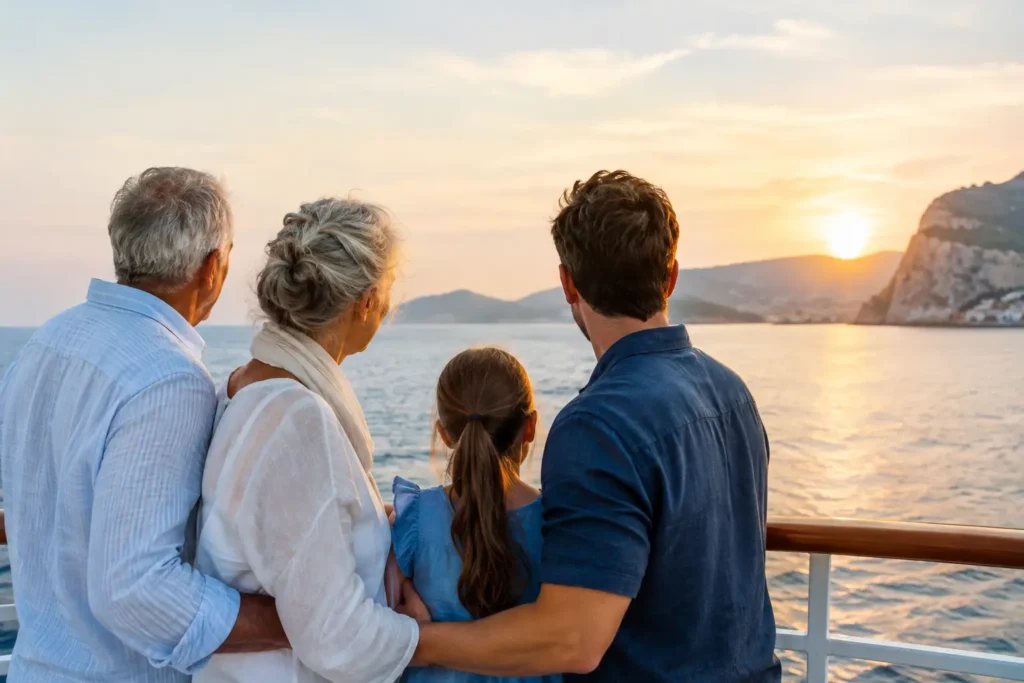
A family legacy voyage begins differently from an ordinary vacation. It may start with a surname on an old document, a faded photograph of a stone house, or a story your grandmother told only once. For families with Croatian, Slovenian, or Dalmatian roots, travel can become a rare opportunity to stand in the places that shaped the people who came before you – while creating a remarkable experience for the people traveling beside you.
The most memorable heritage journeys do not ask you to choose between emotional depth and exceptional comfort. They bring the two together. A private yacht gliding between Adriatic islands, a table set with regional wines, a trusted local guide waiting in a village square – these details create the space to slow down, listen, and let your family story become more real.
What Makes a Family Legacy Voyage Different?
Sightseeing shows you a destination. A legacy-focused journey gives it personal context. The church bell tower is no longer simply beautiful architecture when it is the parish where your great-grandparents may have been baptized. A coastal village is no longer a stop between ports when its cemetery, town archive, or old family home holds a connection to your name.
That distinction matters, particularly for multigenerational travelers. Parents and grandparents often arrive with memories, questions, and inherited stories. Adult children and grandchildren may know less of the history, yet feel its significance most strongly when they can see and experience it firsthand. A well-designed itinerary makes room for both. It is not a genealogy appointment disguised as a vacation, nor is it a luxury cruise with a heritage detail added at the last minute.
Instead, it is a journey shaped around your family’s pace, interests, and level of connection. Some travelers want a full day devoted to archival research and ancestral villages. Others prefer a gentle introduction: a private walking tour, a conversation with a local historian, and dinner featuring recipes rooted in the region. Both approaches can be deeply meaningful.
Begin With the Story You Already Have
You do not need a complete family tree to plan a meaningful journey. A family name, a birth village, an immigration record, a remembered island, or even a general region can offer a valuable starting point. The goal is not always to prove every detail. Often, it is to honor the questions that have traveled through generations.
Before the itinerary takes shape, gather what is available. Ask relatives for names, nicknames, spellings, dates, photographs, letters, and stories of where the family lived before leaving Europe. In this part of the Adriatic, borders shifted, villages carried Italian, German, Croatian, Slovenian, or local variants of their names, and records may be held by a church, municipal archive, or regional institution. A small clue can open a much larger picture.
It also helps to decide what connection would feel most meaningful to your group. Would it be visiting a known ancestral home? Meeting a distant relative, if appropriate and possible? Seeing the harbor from which an ancestor departed? Or simply spending time in the landscape that formed their world? Setting that intention early helps guide every choice that follows.
Design the Journey Around Meaning and Ease
A heritage itinerary works best when it has rhythm. Emotional moments need room around them. After a private visit to an ancestral village, a long lunch at a family-run konoba or a quiet afternoon at sea can be as important as the visit itself. This is where private cruising offers an especially elegant advantage: your accommodations travel with you, and the journey can adjust to your family rather than a fixed group schedule.
A thoughtfully planned Adriatic itinerary might combine four distinct elements:
- A private yacht or boutique vessel for island-hopping, privacy, and an unhurried pace
- Bespoke excursions to ancestral towns, parish churches, local archives, and historic homes
- Cultural experiences such as market visits, cooking with regional ingredients, wine tastings, and conversations with artisans
- Time in landmark cities and UNESCO-listed places that place your family history within the wider story of the region
The balance will depend on your group. A couple celebrating retirement may prefer a quieter route through Dalmatian islands and coastal villages. A family traveling with teenagers may want heritage visits paired with swimming coves, paddleboarding, and lively evenings in Split or Hvar. For a larger family gathering, shared meals and a private guide can turn history into a conversation everyone can join.
Let Croatia and Slovenia Tell a Wider Story
For many American families, ancestry is not neatly contained within one modern national border. A great-grandfather described himself as Dalmatian, Austrian, Italian, Yugoslavian, Croatian, Slovenian, or simply “from the old country,” depending on the time and place. Those identities can overlap, and a sensitive itinerary should respect that complexity rather than reduce it.
Croatia offers a remarkable range of ancestral landscapes, from Istrian hill towns and Kvarner ports to the limestone villages and island communities of Dalmatia. Slovenia adds another dimension, with its Alpine foothills, wine country, Venetian-influenced coast, and deeply preserved local traditions. Traveling through both can reveal how language, food, faith, trade, and migration connected communities across the Adriatic.
That broader context is often what makes a family visit more moving. You may arrive looking for one address and leave with a richer understanding of why your ancestors made certain choices, what they carried with them, and what they may have missed after they left.
The Value of Local Preparation
Heritage travel involves details that cannot always be arranged on the spot. Village homes may be privately owned. Parish offices may have limited hours. Archives may require advance notice, specific requests, or translated names. In some cases, records are incomplete, inaccessible, or do not lead to a definitive answer.
That is not a failure. A carefully prepared journey sets realistic expectations while making the most of every available thread. Optional genealogy research can help identify likely villages, record sources, and family connections before departure. Local experts can also provide cultural context that a document alone cannot offer: how a community lived, how families named children, why people emigrated, and what changed after they departed.
At Adriatic Roots Cruises, the planning process is consultative because no two family stories require the same route. One family may need discreet coordination for a village visit and a day with an archivist. Another may want the heritage component woven lightly into a luxurious week of coastal cruising. The right experience feels personal, never performative.
Make Space for the Unexpected
The moments families remember most are not always the ones listed on an itinerary. It may be a local woman recognizing a family surname. It may be the scent of rosemary outside a stone chapel, a grandfather sharing a story he had never told his grandchildren, or a meal that tastes unexpectedly familiar.
Leave room for these moments. Avoid filling every hour. Build in time to return to a place that moved you, linger over lunch, or change course when a guide suggests a meaningful detour. Private travel is especially valuable here because flexibility is not a luxury extra. It is part of honoring the experience.
It is equally wise to acknowledge that heritage journeys can stir complicated feelings. Families may encounter gaps in the record, evidence of hardship, or places that have changed beyond recognition. Travel does not need to resolve every question to be worthwhile. Sometimes the most powerful result is simply a deeper sense of empathy for those who left and a clearer understanding of the inheritance they gave you.
A Journey Your Family Can Carry Forward
A family legacy voyage is ultimately not about retracing the past perfectly. It is about bringing generations into conversation. When your children or grandchildren hear a family story while looking across the same harbor their ancestors knew, that story gains texture, place, and permanence.
Bring photographs, record conversations with relatives, and ask everyone to keep a few notes during the trip. Those small acts can transform a beautiful journey into part of your family archive. Years later, you may not remember every port or every menu. You will remember where the story became yours again.