
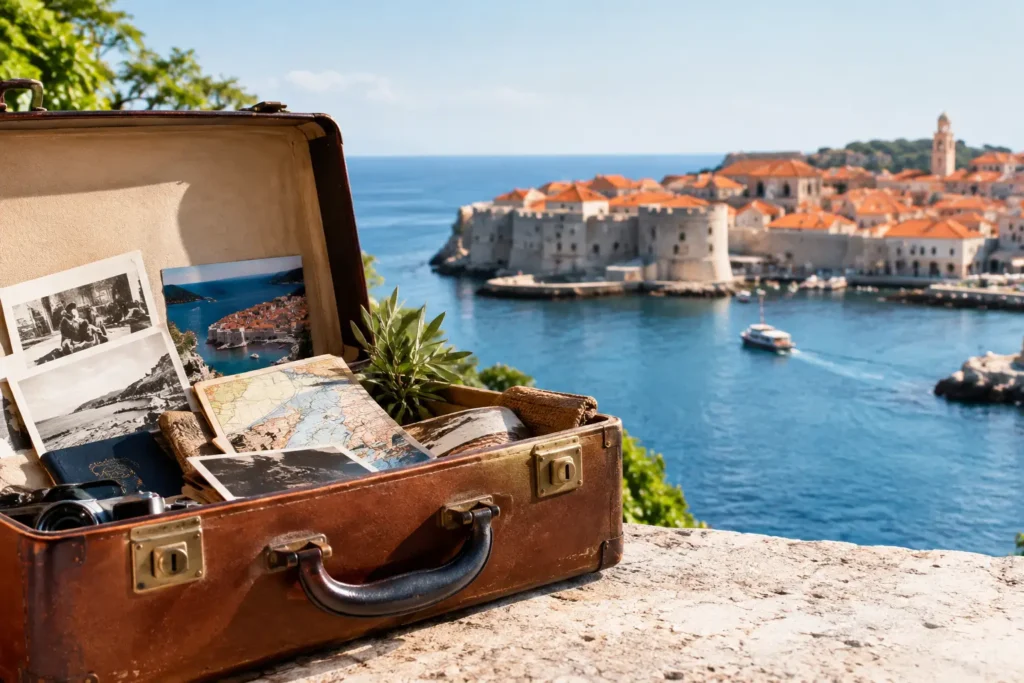
A faded black-and-white photograph can hold more than a face. For one American family, it held the first clue to a village above the Dalmatian coast, a surname that had changed slightly after immigration, and a question shared by three generations: what did home look like before our family left? This family archive travel case study shows how personal records, thoughtful research, and a privately designed Adriatic journey can turn that question into an experience with lasting meaning.
The family did not want a genealogy project conducted from afar, nor did they want to trade comfort for authenticity. They wanted time on the water, exceptional food, beautiful hotels, and space for grandparents, adult children, and grandchildren to experience Croatia together. Their journey needed to honor the past without allowing logistics or research to overwhelm the pleasure of being present.
The family archive travel case study
The family arrived with a modest archive: a handful of letters written in Croatian in the 1920s, baptismal records copied by a relative, an old recipe notebook, several photographs, and stories that had shifted slightly with each retelling. Their grandfather, born in the United States, remembered hearing his parents speak about a stone house, olive trees, and a parish feast day. He did not know the precise address. His daughter had spent years trying to identify the village online, but found conflicting spellings and records spread across different jurisdictions.
That is often where heritage travel becomes complicated. A family archive can be emotionally rich yet factually incomplete. Names may be Americanized, village borders may have changed, and a photograph may be labeled only “home.” The work is not simply finding an ancestral point on a map. It is understanding what can be confirmed, what remains family memory, and how to design a journey that feels meaningful in either case.
Before departure, the family’s materials were reviewed alongside available local records and historical context. A likely village was identified in the hills above Makarska, along with the parish connected to the surname in the letters. Rather than promising a perfect archival answer, the itinerary was built around well-supported discoveries and room for the unexpected. That distinction matters. Heritage travel is most powerful when it is honest about uncertainty while still making space for connection.
Beginning in Split, with room to arrive
The family began in Split, where a private welcome allowed everyone to settle in after an overnight flight. This was not a rushed transfer from airport to sightseeing. The first afternoon was intentionally gentle: time at a refined waterfront hotel, a relaxed family dinner, and an introduction to the days ahead.
The following morning, a private historian guided them through Diocletian’s Palace. The experience gave the family a foundation for the region their ancestors knew, including the layers of Roman, Venetian, Austro-Hungarian, and Croatian life that shaped Dalmatian identity. For the grandchildren, history became tangible in narrow stone lanes and sunlit courtyards rather than a lecture. For the older generation, it offered context for the stories that had traveled across the Atlantic.
That evening, the family boarded their private yacht. A yacht is not merely a luxurious setting for this kind of journey. It changes the rhythm of the experience. Each family member had a private cabin and quiet space when needed, while shared meals and open decks created natural moments for conversation. The itinerary could also move with the family’s energy. A long lunch on a quiet island cove was possible because no large-group schedule dictated the day.
A village visit designed with care
The emotional center of the journey came on the mainland. After anchoring near the Makarska Riviera, the family traveled by private vehicle into the hills with their local guide and interpreter. The route passed vineyards, fig trees, and dry-stone walls, offering a landscape that made the old photographs feel less distant.
The village was small, and that required discretion. An ancestral visit should never feel like arriving to claim ownership of someone else’s community or interrupt daily life in search of a dramatic reveal. In advance, the visit had been arranged respectfully through local contacts. The parish church was open, the cemetery was visited quietly, and a local resident familiar with the village’s older families shared what she knew about the surname.
There was no movie-style moment in which a stranger opened the door and announced a newly discovered branch of the family. Instead, there was something more believable and, in its own way, more moving. The family stood beside several graves bearing variations of their name. They saw the church where previous generations likely marked baptisms, marriages, and funerals. Their guide pointed out the valley route many residents would have taken toward the coast before emigrating.
The grandfather placed a small bouquet near a family grave. His granddaughter read a translated passage from one of the letters, written by a young man preparing to leave for America. No one needed to manufacture emotion. The setting, the records, and the family’s presence were enough.
Letting the journey remain a vacation
A heritage itinerary can become too intense if every day is dedicated to archives, churches, and ancestral sites. This family specifically wanted the trip to feel celebratory, not solemn. The days that followed were designed accordingly.
They sailed to Hvar for an afternoon of swimming and a private tasting focused on island wines and olive oils. On Korčula, the family explored at an unhurried pace, then joined a chef for a dinner inspired by recipes and ingredients associated with their own family notebook. The menu was not presented as an exact recreation of their great-grandmother’s cooking. It was a thoughtful interpretation, grounded in local traditions and the flavors that had likely traveled with her to the United States.
This balance is especially valuable for multigenerational travel. One family member may care most about the parish record; another may be there for the Adriatic, the food, and the pleasure of time with people they rarely see at home. A well-designed journey allows both desires to coexist. The heritage story gives the trip depth, while the private yacht, carefully chosen restaurants, and beautiful coastal stops make it a true escape.
What made the experience feel personal
The details mattered as much as the major moments. The family had a dedicated guide who understood both regional history and the sensitive nature of personal discovery. Transfers were private, timing was flexible, and meals accommodated individual preferences without turning the journey into a series of decisions. The grandparents could rest after the village visit while the younger adults took a swim. The children had room to be curious without being expected to absorb every historical detail.
The itinerary also included a small printed family journey book, prepared for the trip. It held copies of selected photographs, a simple timeline, maps, translated letter excerpts, and blank pages for reflections. By the end of the cruise, it contained restaurant notes, a pressed sprig of rosemary, sketches by the grandchildren, and names of places that had once existed only in family stories.
This is where a tailored approach differs from adding one heritage excursion to a conventional cruise. The archive informed the route, pace, guides, and experiences from the beginning. Luxury was not separate from the family story. It gave the family the privacy, ease, and time needed to experience that story fully.
What this case study reveals about heritage travel
The most successful roots-based journeys do not rely on a single extraordinary discovery. Sometimes research leads to a precise house, a distant cousin, or a long-lost record. Sometimes it leads to a village, a churchyard, and a deeper understanding of why a family left. Both outcomes can be profoundly valuable.
It also depends on the family’s expectations. Travelers seeking formal genealogical proof may need more research before travel, particularly when records are incomplete or names are common. Travelers who want to feel the geography, culture, and daily texture behind their family history may find that a carefully planned visit brings clarity that documents alone cannot offer.
For this family, the lasting memory was not one revelation. It was the way their history became shared experience: a letter read in the place it described, a toast raised over the sea, and three generations realizing that their story had always extended beyond the place they called home. The most meaningful journeys do not simply show you where your family came from. They give you time to feel what that connection means now.