
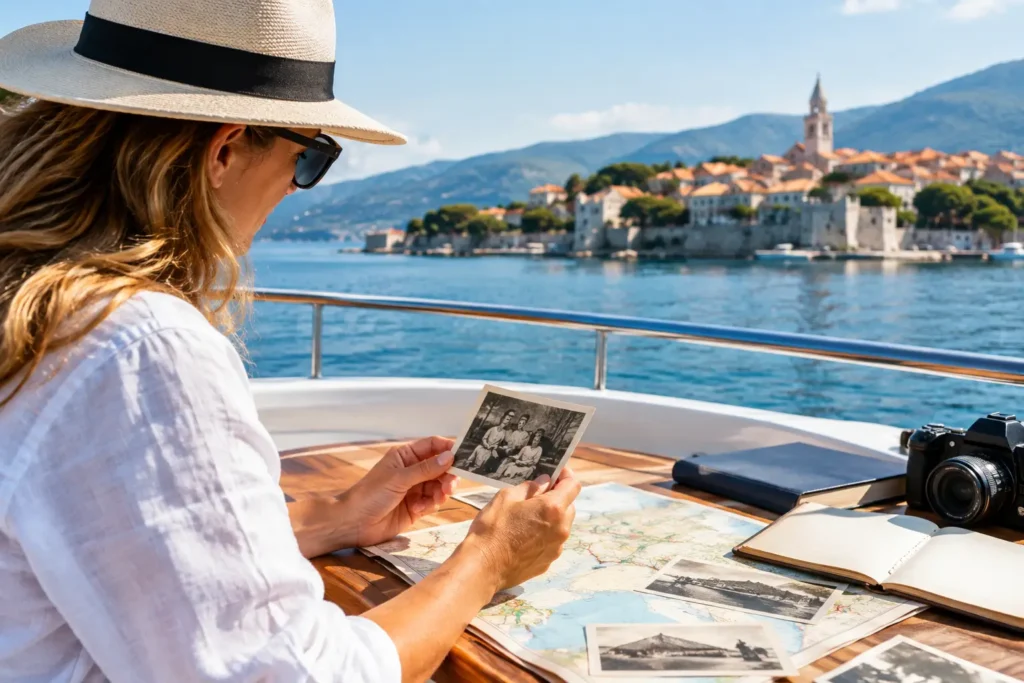
A family name on an old document can lead surprisingly far: to a stone house above the sea, a parish register in a quiet inland town, or a harbor your grandparents may have known by another name. To combine genealogy with cruising is to give those discoveries the time, setting, and care they deserve. Rather than rushing from one hotel to the next, you can travel the Adriatic in comfort while following the places that shaped your family story.
For travelers with Croatian, Slovenian, Dalmatian, Istrian, or wider Adriatic roots, this is not simply a more elegant way to tour the coast. It is a chance to see family history as a living landscape: islands, villages, churches, markets, recipes, dialects, and sea routes that still connect communities today.
Why genealogy belongs on an Adriatic cruise
A conventional genealogy trip often asks you to choose between research and pleasure. You may spend days navigating unfamiliar roads, arranging local appointments, and trying to interpret records in another language, leaving little room to absorb what you have found. A thoughtfully planned cruise changes the rhythm.
Your yacht or boutique ship becomes a private, comfortable base as the coastline unfolds outside your window. One day might be devoted to a guided visit to an ancestral village; the next might bring a leisurely sail toward Hvar, Korčula, or the Istrian coast, with a long lunch at a family-run konoba and time to reflect on the stories gathered along the way.
This approach is especially well suited to the Adriatic. Many families moved between islands and mainland ports, or left from Trieste, Rijeka, Split, Dubrovnik, and smaller coastal communities for the United States and elsewhere. The water was not a boundary in their lives. It was a route home, a source of work, and often the first stage of a much larger journey.
Cruising also offers a meaningful answer to a practical challenge: ancestral places are rarely arranged along a convenient tourist route. A custom itinerary can combine coastal access with private drivers for inland visits, avoiding the exhaustion of changing hotels every night or trying to make a fixed group-cruise schedule fit a deeply personal purpose.
Begin with the story you already have
You do not need a complete family tree before you travel. In fact, many guests begin with only a surname, a town written on an immigration record, a faded photograph, or a memory passed down at the dinner table. These fragments are valuable starting points.
Before planning your journey, gather what you can: full names, maiden names, approximate dates of birth, immigration papers, naturalization records, letters, military documents, family Bible entries, and any old place names. Croatian and Slovenian borders, municipalities, and spellings have changed over time, so the name on a century-old record may not appear exactly as expected on a modern map.
The goal is not to arrive with every answer. It is to create a clear research brief that helps local experts distinguish between similarly named villages, understand historic jurisdictions, and identify the records most likely to illuminate your family’s path. Sometimes the strongest result is a confirmed address or parish. Sometimes it is meeting a distant relative. Sometimes it is simply standing in the right place and understanding why your ancestors left.
Let research shape the route, not overwhelm it
Genealogy works best when it guides an itinerary without taking it over. A trip built entirely around archives can become demanding, particularly for multigenerational families whose interests differ. On the other hand, treating heritage as a single afternoon stop can feel thin when it is the reason you came.
The right balance depends on your priorities. A serious researcher may want a dedicated day with a local genealogist and translator, while a family celebrating an anniversary may prefer one intimate ancestral visit framed by beautiful coastal days. Both can be deeply meaningful when the pace is designed around your story.
How to combine genealogy with cruising gracefully
The most successful heritage voyages are planned in layers. First comes the family narrative: where your people lived, what they did, and which places hold emotional importance. Then comes the travel design: the season, vessel, preferred level of privacy, desired pace, and the mix of sea, culture, and time ashore.
A private yacht offers the greatest flexibility. It can adjust its sailing plan around a village visit, an intimate dinner, or an unhurried afternoon in a place that feels unexpectedly significant. A boutique ship can be an excellent fit for travelers who value a sociable atmosphere and refined service, provided the shore program leaves room for private excursions.
From there, heritage experiences can be woven naturally into the voyage. You may visit the church where generations were baptized, walk through an old family neighborhood with a historian, or arrange a meeting with local residents who share a surname or community connection. A regional guide can add the context records alone cannot provide: how people lived, which crops sustained a village, what a particular festival means, and why so many young people departed for America.
Luxury matters here not as ornament, but as space. It gives you time to arrive without rushing, privacy for emotional moments, and the ease to share discoveries with those traveling beside you. After a meaningful morning in your ancestral village, returning to a calm deck, a beautifully prepared meal, and the open water can be part of the experience rather than a detour from it.
A journey can hold both discovery and delight
Imagine beginning in Split, where a private guide introduces the layered history of Dalmatia before you set sail. You spend an afternoon in a small inland community connected to your maternal family, visiting the parish church and hearing local stories that make familiar names feel real. That evening, the yacht anchors in a quiet bay, and dinner features dishes shaped by the same coastal traditions your family carried abroad.
Later, the itinerary may turn toward Korčula or the Pelješac Peninsula, perhaps including a winery visit, a cooking experience, or a walk through a walled old town. If your roots extend north, the journey might continue toward Istria, Rijeka, or Slovenia, pairing historic port cities with hill towns, vineyards, and archival research in a regional center.
Not every revelation will be dramatic. A family home may no longer stand. Records may be incomplete, or a surname may be common enough to prevent a definitive connection. These are real possibilities, and a responsible heritage journey should never promise discoveries that records cannot support.
Yet even when the archival trail stops, place can offer a different kind of understanding. You may recognize the steepness of the road described by a grandparent, hear a local phrase that survived in your family, or see the distance between a village and the sea. Those details can make inherited stories more dimensional and help the next generation feel their place within them.
Make room for the people traveling with you
Heritage travel is often most powerful when shared, but families do not experience it in the same way. One person may be drawn to documents and dates; another may care more about food, architecture, or a chance to slow down together. A well-designed itinerary honors all of those motivations.
For multigenerational groups, consider alternating research-focused mornings with relaxed afternoons for swimming, sailing, or independent exploration. Build in a special family dinner after an ancestral visit, where stories can be recorded, photographs can be shared, and younger relatives can ask questions they may not have thought to ask at home.
There is also value in leaving some moments unplanned. A conversation with a local host, a familiar-looking family name on a mailbox, or a stop at a village cemetery may become the memory everyone carries home. An itinerary should be carefully orchestrated, but never so rigid that it cannot welcome the unexpected.
The value of local expertise
Planning a roots-based Adriatic journey from the United States can be complicated. Place names may have historic variants, church and civil records are held in different locations, and appointments may require advance coordination and local-language communication. Even reaching a small village can involve a transfer that is simple for a regional specialist but difficult to arrange from afar.
This is where a consultative approach matters. Adriatic Roots Cruises designs each journey around the traveler rather than fitting a family story into a pre-set route. Research support, private guides, drivers, vessel selection, accommodations, and meaningful cultural experiences can all be considered as one connected experience.
The distinction is important. The best heritage travel is not a standard cruise with an ancestral stop added at the end. It is a voyage in which your family history informs the route, while the pleasures of the Adriatic ensure the journey remains generous, restorative, and beautifully lived.
Bring your documents, your questions, and the stories that have followed your family across generations. The Adriatic may not answer every question, but it can offer something rarer: the feeling that your history is no longer distant. It is in the landscape before you, waiting to be known.