A harbor can hold more than beautiful water and stone. For travelers with Croatian, Slovenian, or Dalmatian roots, it may hold a family departure point, the parish that recorded a great-grandparent’s baptism, or the first view an ancestor carried with them across an ocean. The best stops for coastal heritage are not simply the most photographed places on the Adriatic. They are the places where history remains tangible, local life still has texture, and your own story can be given the time and care it deserves.
A private cruise creates a particularly graceful way to experience these places. You can arrive before the day crowds, remain for an unhurried dinner in a centuries-old square, and combine celebrated landmarks with the lesser-known villages that may matter most to your family. The right route depends on your roots, the season, and how much you want to balance grand history with quiet personal discovery.
What Makes a Coastal Stop Meaningful
Heritage travel is most rewarding when it has layers. A UNESCO-listed old town may provide the historical frame, while a conversation with a local guide, a visit to a family church, or a meal featuring recipes of the region brings that history closer. The Adriatic is especially rich in these layers: Roman ports, Venetian fortifications, medieval republics, Slavic island communities, and fishing traditions all exist within a remarkably compact coastline.
For a family journey, practical details matter as much as romance. Some historic centers have steep steps and polished limestone streets. Certain island villages are best reached by tender or private car. Summer brings a lively atmosphere but also more visitors, while May, June, September, and early October often allow for a more intimate pace. A tailored itinerary can account for mobility, family ages, research appointments, and the simple wish to linger where the connection feels strongest.
1. Dubrovnik: A Grand Beginning for a Family Story
Dubrovnik is often the Adriatic’s most dramatic arrival. Its formidable walls, baroque facades, and gleaming stone lanes tell the story of the former Republic of Ragusa, a maritime power that maintained connections across the Mediterranean and beyond. For descendants of families from the Dubrovnik region, the city offers a powerful sense of the world their ancestors may have known: trade, faith, diplomacy, and a fiercely independent coastal identity.
The Old Town deserves early-morning attention, before its streets fill. A private guide can place familiar landmarks in context, from the Rector’s Palace to Franciscan traditions and the city’s historic gates. Yet Dubrovnik is most meaningful when paired with the surrounding landscape. The Konavle region south of the city offers village churches, vineyards, embroidery traditions, and a gentler rhythm that reveals another side of local life.
2. Korčula: Stone Lanes and Island Continuity
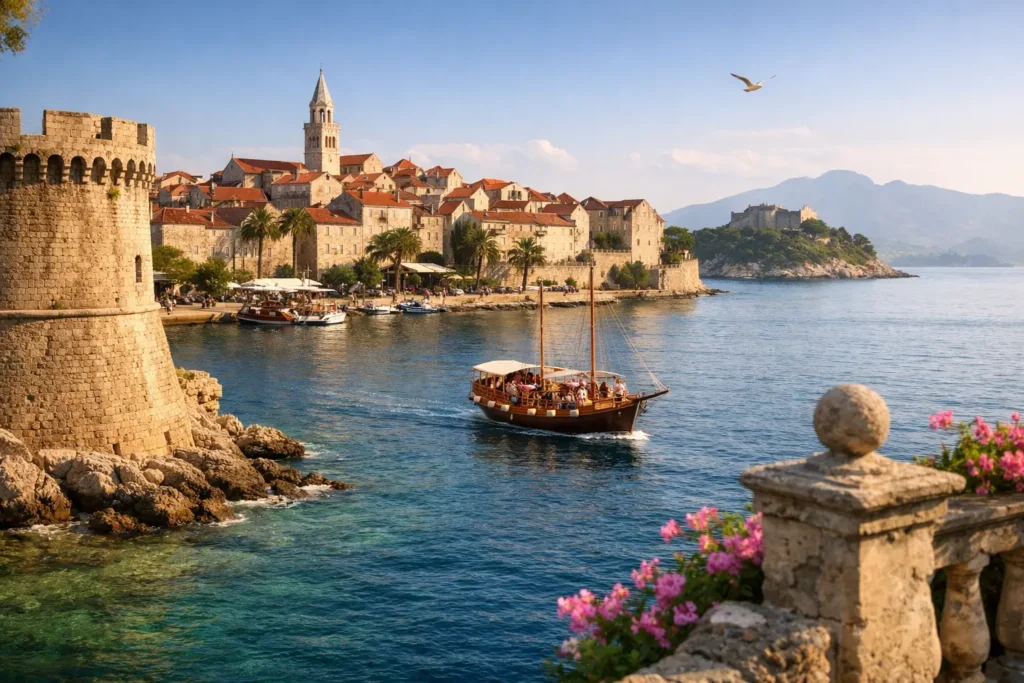
Korčula has the elegance of a miniature walled city, but its appeal goes beyond its handsome medieval layout. The island has long been shaped by seafaring, stonemasonry, olive growing, and close-knit village life. Its old town, set on a narrow peninsula, is ideal for a leisurely private walk that connects architecture with the practical realities of an island community.
For heritage-minded travelers, Korčula can be especially resonant because it feels lived in rather than preserved behind glass. Beyond the town walls, villages such as Lumbarda and Žrnovo reveal vineyards, family-run konobas, small chapels, and dialects that carry a distinct local character. This is a beautiful place to include a private olive oil tasting or a home-style lunch, particularly for families who want a gathering to feel personal rather than programmed.
3. Hvar and Stari Grad: Two Faces of Dalmatian Heritage
Hvar Town brings glamour, Venetian architecture, and a polished harbor scene, making it a natural choice for travelers who want heritage and high style in the same day. Its arsenal, cathedral square, and hilltop fortress speak to centuries of maritime importance. It is a compelling stop for an evening ashore, when the light softens over the harbor and dinner can unfold at an easy pace.
For deeper historical grounding, Stari Grad is the more revealing counterpart. One of Europe’s oldest towns, it sits beside the Stari Grad Plain, a remarkably enduring agricultural landscape first organized by Greek settlers more than two millennia ago. Stone walls and field divisions still shape the land. A visit here is a reminder that coastal heritage is not only about walled cities. It is also about the vineyards, labor, and inherited knowledge that sustained island families for generations.
4. Split and Salona: Roman Scale, Dalmatian Soul
Split is built into a Roman emperor’s retirement palace, but it has never been a static monument. Diocletian’s Palace is a living urban center where apartments, shops, churches, cafés, and courtyards occupy spaces once intended for imperial life. That blend makes Split particularly vivid for travelers seeking a sense of continuity. The city’s past is not separate from its present.
A thoughtful day here often includes Salona, the extensive Roman ruins just outside the city. Once the capital of the Roman province of Dalmatia, Salona offers a broader view of the world from which Split emerged. Its amphitheater, basilicas, and ancient streets help place family roots within a much longer regional story. The trade-off is that Split can be energetic and crowded in peak season, so private timing and a well-paced plan make a considerable difference.
5. Trogir: A Small Town with Remarkable Detail
Trogir is a short distance from Split yet feels entirely distinct. Its compact island old town is a masterclass in Romanesque, Gothic, Renaissance, and Venetian design, with the Cathedral of St. Lawrence at its center. It is small enough to absorb in a few unhurried hours and detailed enough to reward close attention.
This is an excellent stop for multigenerational groups. The distance from a yacht berth or private transfer is manageable, the lanes invite slow exploration, and a local guide can make the architecture approachable for every age. Trogir also works beautifully as a place to pause rather than rush. A late lunch overlooking the water can become one of those unscripted family moments that stays in memory long after the trip.
6. Šibenik: The Adriatic at Its Most Distinctive
Šibenik is frequently overlooked in favor of its better-known neighbors, which is precisely part of its charm. Unlike many coastal cities with ancient Greek or Roman origins, it was founded by Croats. Its Cathedral of St. James, built entirely of stone, is a landmark of extraordinary craftsmanship, with a frieze of carved faces that feels startlingly human.
The city’s heritage is best understood with time beyond the cathedral. Its hillside lanes, fortresses, and waterfront tell a story of defense, civic pride, and maritime life. Šibenik is also well positioned for families whose ancestral research leads inland toward the Krka region or smaller Dalmatian communities. A customized itinerary can use the city as a refined base before continuing to a village visit, cemetery, parish, or family home area.
7. Zadar: Where Roman Foundations Meet Living Tradition
Zadar has endured Roman rule, Venetian influence, wartime destruction, and a modern revival without losing its distinctive character. The Roman forum, the Church of St. Donatus, and the old town’s defensive walls offer a compact history lesson, but the city’s spirit is felt most clearly in its evening promenade. Locals gather there as the sun drops over the islands, preserving a social ritual that is as meaningful as any monument.
For travelers tracing roots in northern Dalmatia, Zadar can be a natural gateway to island and mainland communities that are harder to navigate independently. It is also a rewarding choice for those who prefer a city with heritage substance but a less formal atmosphere than Dubrovnik or Split. Here, a private guide can connect the visible landmarks with stories of migration, fishing, agriculture, and the resilience of local families.
Designing the Best Stops for Coastal Heritage Around You
The most moving Adriatic itinerary rarely follows a standard route exactly. One family may begin in Dubrovnik, sail north through Korčula and Hvar, then spend a meaningful afternoon in a village near Šibenik. Another may focus on Zadar and the northern islands, pairing archival research with time in places where grandparents once lived. A couple marking an anniversary may want the grandeur of Split and Dubrovnik, softened by private vineyard lunches and quiet anchorages in between.
At Adriatic Roots Cruises, the planning begins with the places, questions, and memories that matter to you. That may mean arranging a knowledgeable local guide, allowing space for genealogy research, or simply making sure your family reaches an ancestral town without sacrificing comfort or privacy. The finest heritage journeys leave room for discovery. Sometimes the most significant moment is not a famous view, but a name on a church record, a familiar surname spoken by a local, or the feeling of standing beside the sea and understanding why your family carried it with them.