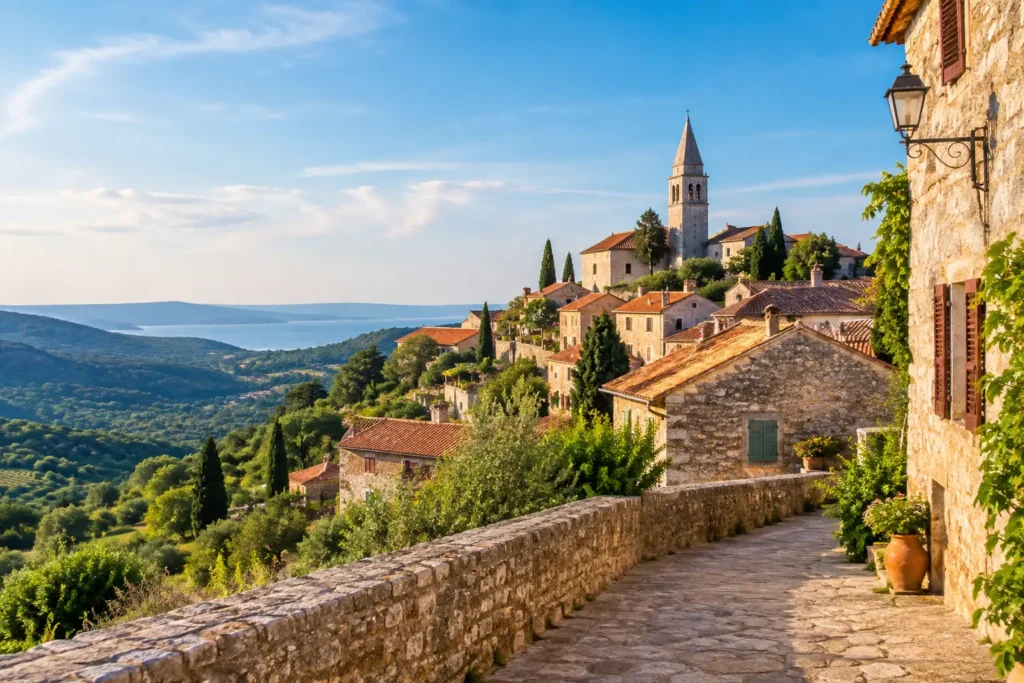
A family name can take on a different weight when you see it carved into a weathered lintel, hear it pronounced by a local historian, or find it in a parish book kept in a quiet hilltop church. The best Istrian villages for heritage travel offer precisely that kind of encounter: not a staged version of the past, but places where Venetian, Slavic, Italian, Austro-Hungarian, and rural Istrian histories remain visible in the stones, languages, food, and family memory.
Istria is compact enough to travel slowly and well. A private driver can carry you from the coast to the interior in little more than an hour, yet each hilltop settlement has its own rhythm and identity. For travelers reconnecting with Croatian, Slovenian, or wider Adriatic roots, that closeness creates a rare opportunity to pair archival discovery with beautiful stays, unhurried meals, and meaningful time in the places that shaped a family story.
What makes an Istrian village meaningful for heritage travel?
The most rewarding villages are not always the most famous. A strong heritage stop should offer more than a picturesque central square. Look for intact historic fabric, churches and cemeteries that may help place a family in context, local people who understand the area’s layered identity, and practical access to nearby towns where municipal, parish, or regional records may be held.
Some villages are polished and lively, with galleries and fine dining. Others are quieter, more atmospheric, and better suited to travelers seeking reflection. The right choice depends on your story. If your ancestors came from a specific hamlet, that place matters most, even if it has only a few dozen residents. If you are beginning with a surname, an old empire-era district, or a broader Istrian connection, these seven villages make an exceptional starting point.
1. Motovun
Rising above the Mirna River valley, Motovun is one of Istria’s most dramatic heritage settings. Its fortified walls, Romanesque and Gothic details, Venetian lion, and wide views over truffle country give visitors an immediate sense of the region’s strategic past. This was a place shaped by medieval authority, Venetian administration, agriculture, and trade, all layered into a remarkably compact hilltop town.
For a roots-focused journey, Motovun works beautifully as a first introduction to inland Istria. Walk the walls with a private guide before the day-trippers arrive, then continue into the valley for a truffle-focused lunch or a visit with a local producer. It is more animated than some smaller villages, so travelers seeking absolute quiet may prefer to stay nearby and visit Motovun as part of a tailored day.
2. Grožnjan
Grožnjan feels intimate rather than monumental. Its stone lanes, shuttered homes, small squares, and creative studios have earned it a reputation as Istria’s town of artists, particularly during the summer music season. Yet beneath that artistic character lies a complex cultural history shaped by the region’s Italian-speaking and Croatian-speaking communities.
That dual inheritance makes Grožnjan especially compelling for families whose records, surnames, or oral histories cross linguistic lines. Place names may appear in Croatian, Italian, German, or Latin depending on the period and source, and a knowledgeable guide can help make those shifts feel less confusing. A private visit here can combine architecture and local art with a thoughtful conversation about the changing borders and identities that shaped Istrian families.
3. Oprtalj
Oprtalj is for travelers who want to feel the quieter pulse of old Istria. Perched high above the Mirna valley, it has an almost suspended quality: worn stone passages, fragments of defensive walls, a Venetian-style loggia, and views that invite you to linger. It is less restored and less commercial than Motovun, which is exactly its appeal.
For heritage travelers, Oprtalj offers a powerful sense of scale. Many ancestors did not come from grand cities or famous ports. They came from small agricultural communities where olive growing, wine, livestock, and seasonal work defined daily life. A visit here can help a family imagine that world with greater clarity, especially when paired with a village-style meal and time in the surrounding countryside.
4. Hum
Hum is often described as one of the world’s smallest towns, but its value is not a novelty sign or a quick photograph. Within its compact walls, you find a parish church, narrow stone streets, medieval traces, and a tangible connection to Glagolitic culture, the early Slavic script once used across parts of Croatia.
Hum is an excellent stop for families interested in language, faith, and the older cultural layers of the peninsula. It is small enough to experience in an hour, so it works best as part of a private route through central Istria rather than as a full-day destination. The nearby Glagolitic Avenue adds context, connecting the village to a heritage that reaches beyond any one family line.
5. Draguć
Draguć has the quiet visual power of a remembered village. Often chosen as a filming location for its nearly untouched streetscape, it sits on a ridge above inland Istria with stone houses, old gates, churches, and far-reaching rural views. There is little pressure to do anything quickly here.
This is a particularly moving choice for travelers who value atmosphere over amenities. The village helps explain why people left as much as why they remained. Across the late nineteenth and twentieth centuries, many Istrian families navigated poverty, migration, political change, and shifting national identities. Standing in Draguć, those abstract historical forces become more human. A local historian can add important nuance, preventing family narratives from being reduced to a single label or era.
6. Bale
Bale, known in Italian as Valle, brings a different texture to a heritage itinerary. Closer to the western coast, it blends medieval and Venetian-era architecture with a more refined, lived-in elegance. The old center is exceptionally walkable, with stone facades, narrow lanes, small courtyards, and the prominent Soardo-Bembo Palace anchoring its historic character.
Bale suits multigenerational groups particularly well because it balances cultural depth with comfort. It can be paired with a leisurely seafood lunch, an olive oil tasting, or an afternoon on the coast without losing the sense of place. For travelers whose roots are connected to western Istria, it also provides useful context for the region’s long relationship with Venice, maritime trade, and coastal migration.
7. Svetvinčenat
At the heart of Svetvinčenat stands the Morosini-Grimani Castle, a powerful reminder that Istria’s village life was once organized around noble estates, fortified centers, and agricultural hinterlands. The town’s broad Renaissance square feels more open than the winding lanes of the hilltop villages, offering a graceful setting for understanding the social structures that influenced local life.
Svetvinčenat is ideal for travelers who appreciate architecture and want a heritage visit with a sense of ceremony. It also pairs naturally with private culinary experiences in southern central Istria. After time in the castle and square, a host-led meal featuring local wines, olive oil, and seasonal ingredients can turn historical context into something personal and memorable.
How to shape a heritage journey through Istria
The strongest itinerary does not try to collect every beautiful village in two days. Choose two or three places that speak to your family geography, then allow room for private conversations, church visits where appropriate, regional archive research, and meals that are not rushed. A journey centered on a specific ancestral village may need flexibility, since record access, local holidays, and family introductions cannot always be scheduled like museum tickets.
Language also deserves care. Istrian records may use alternate spellings, translated first names, or historic place names that no longer appear on modern maps. A surname search is a valuable beginning, not proof of a direct connection. The most respectful approach is to arrive with curiosity and let qualified local researchers, historians, and community members help distinguish family fact from family legend.
For guests traveling by private yacht along the Adriatic, Istria can become a beautifully paced land extension: a few nights in an elegant inland retreat, curated drives through the peninsula, and time to return to the coast when the story is ready to continue. Adriatic Roots Cruises designs these days around the details that matter most, whether that is a grandmother’s birthplace, a parish name found in old papers, or simply a desire to understand the region that shaped your family.
The real luxury of Istria is not rushing from one stone village to the next. It is having enough time to stand in a quiet square, listen for the echoes of your own story, and leave with a deeper sense of where it began.