
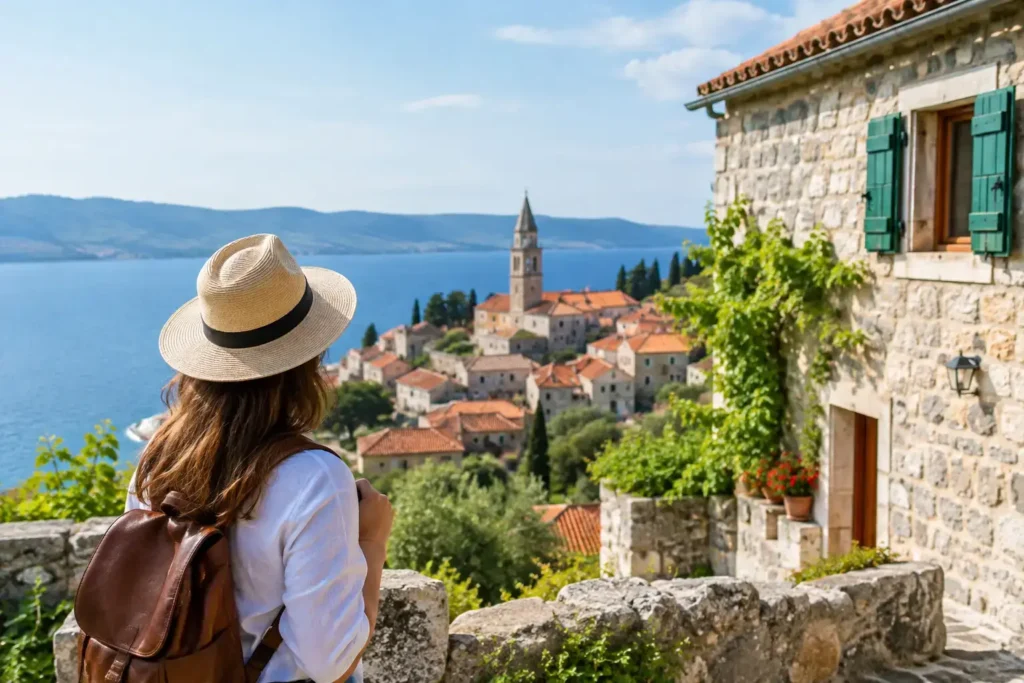
A faded address on a ship manifest. A village name spoken by a grandparent but never found on a map. A family photograph showing a stone house, a fig tree, and a hillside that may still look familiar generations later. For many travelers, the question is not simply can Americans visit ancestral homes, but whether they can stand in the place where their family story began.
In Croatia and Slovenia, the answer is often yes, with an essential distinction: you may be able to visit the village, locate the property, speak with local residents, and see the home from the road or surrounding land. Entering a privately owned home, courtyard, or property requires the current owner’s clear permission. A meaningful heritage visit is built on that respect.
When planned with care, an ancestral-home visit can become the emotional center of a larger Adriatic journey. It is not about claiming a place that no longer belongs to your family. It is about honoring the people who left it, understanding the landscape that shaped them, and creating room for connection in the present.
Can Americans Visit Ancestral Homes? Yes, With Respect
American citizens can travel to Croatia and Slovenia for tourism without needing ancestry-based citizenship or special permission to visit an ancestral town. Entry requirements can change, so travelers should confirm current passport and travel rules before departure, but genealogy alone does not restrict a visit.
The more sensitive question concerns the house itself. A property may still be in the hands of distant relatives, may have been sold long ago, or may no longer exist. It may now be a family residence, a working farm, a vacation home, or an entirely rebuilt structure. Even when a home has been vacant for years, it is not automatically open to visitors.
The most gracious approach is to view an ancestral address as an invitation to research, not an entitlement to access. A local guide, genealogist, or trusted regional contact can help identify the current situation before you arrive. If the owner welcomes a visit, a brief conversation at the gate can be extraordinary. If they prefer privacy, the village church, cemetery, lane, or landscape can still tell a profound story.
Begin With the Details You Already Have
The strongest heritage itineraries begin well before the first day at sea. Small details that seem incomplete at home often become highly useful once paired with local knowledge. Gather family records, old correspondence, naturalization papers, military documents, photographs, and the names of relatives who remained in Europe.
Place names deserve particular attention. Borders shifted repeatedly across this region, and an ancestor who described their birthplace as Austria, Yugoslavia, Italy, or Hungary may have come from a village in present-day Croatia or Slovenia. Names were also frequently Anglicized after immigration. A surname spelling found in a US census may differ from the spelling preserved in a parish register.
Try to establish three anchors: the ancestor’s full name, an approximate year of birth or departure, and the smallest known place of origin. A region such as Dalmatia is a beginning, but a municipality, parish, hamlet, or island makes focused research far more possible. If you have only a family story, that is still enough to begin. It simply calls for more patient investigation.
What a Local Researcher Can Clarify
Genealogy research is not always a straight line, particularly in villages where many families share the same surname. An experienced local researcher can examine parish records, civil registries, land documents, cemetery inscriptions, and local histories. They may be able to distinguish between two villages with similar names, identify an old house number, or determine whether the family’s original home is still standing.
Research can also reveal surprises. Your ancestor may have lived in one village but been baptized in another. The family may have moved between an inland community and a coastal port. A surname thought to be Croatian may lead to a Slovenian border region, or to a community shaped by Italian, German, Jewish, Serbian, or other Adriatic influences. These discoveries do not dilute your story. They make it more true.
A Visit Should Feel Personal, Not Intrusive
An ancestral-home visit is at its best when it is carefully paced. Rather than arriving with a large group and an expectation of entry, allow time to approach the place quietly, observe the surroundings, and let a guide explain what is known. The shape of the road, the distance to the church, the view toward the sea, and the fields beyond the village may offer a more vivid understanding of family life than a formal tour ever could.
If contact with current residents has been arranged, arrive with humility. A small gesture of appreciation may be appropriate, but it should never feel transactional. A translated family photograph or a short note explaining your connection can be more meaningful than an elaborate gift. Ask before taking photographs, especially of people, interiors, and private grounds.
Language can be another tender detail. Many residents speak English, particularly in coastal areas and cities, but a local interpreter or guide can make introductions warmer and avoid misunderstandings. They also understand the rhythms of village life, including when a visit may be unwelcome because of work, religious observances, or family events.
Not every door will open. That does not mean the day has failed. Sometimes the most moving moment is simply hearing your ancestor’s surname pronounced as it would have been in their childhood village, or placing flowers at a cemetery where relatives are buried.
Build the Journey Around the Place, Not Just the Address
A single home rarely tells the entire story. The most satisfying heritage travel places that home within its wider world. In Croatia, that may mean following an inland family village with time in Split, Dubrovnik, Hvar, Korčula, or the quieter islands that once connected communities by sea. In Slovenia, it may mean pairing a village visit with Ljubljana, the Karst region, wine country, alpine landscapes, or the coast near Piran.
A private Adriatic cruise offers a particularly graceful way to make those layers feel connected. After an emotionally charged day in a family village, returning to the comfort and privacy of a yacht or boutique vessel creates space to reflect. There is no need to rush into the next scheduled attraction. Dinner can be arranged around regional dishes your ancestors may have known, while the next day might bring a secluded island, a historic port, or a winery chosen for its connection to the region.
For multigenerational families, this balance matters. One traveler may be deeply invested in church records and family names, while another dreams of swimming in clear water or lingering over a long coastal lunch. A journey designed around your story can hold both desires without reducing the heritage experience to a quick stop between sightseeing.
Plan for What May Be Uncertain
Heritage travel rewards preparation, but it also asks for flexibility. Records may be incomplete. The old house number may no longer correspond to a modern address. A property owner may not respond to an inquiry, or a road may be inaccessible after weather or seasonal closures. In smaller communities, local knowledge can be invaluable, but it should be approached discreetly rather than treated as a demand for answers.
It is wise to create a layered plan. The first layer is the exact home or property, if it can be identified and permission is possible. The second is the ancestral village: church, cemetery, square, school, harbor, or local museum. The third is the broader region, where food, architecture, music, and landscape provide the cultural context your family carried across the Atlantic.
This approach protects the emotional value of the journey. Even if the precise house is unreachable, you have not traveled across the world for a closed gate. You have traveled to meet the place behind the family memory.
When a Curated Heritage Journey Makes a Difference
Independent research can be rewarding, but it can also become complicated quickly when old place names, language differences, property boundaries, and tight travel schedules meet. A tailored journey brings those practical details together with the level of comfort a milestone trip deserves.
At Adriatic Roots Cruises, heritage visits can be woven into private cruising and land arrangements with local guides, thoughtful introductions, elegant accommodations, and time reserved for the unscripted moments that cannot be planned. The goal is not to turn family history into a performance. It is to make space for it, beautifully and respectfully.
The house itself may be changed beyond recognition, or it may be exactly where family memory placed it. Either way, the journey can offer something lasting: the chance to see the horizon your ancestors left behind, and to carry that view home with a deeper sense of where your story began.