
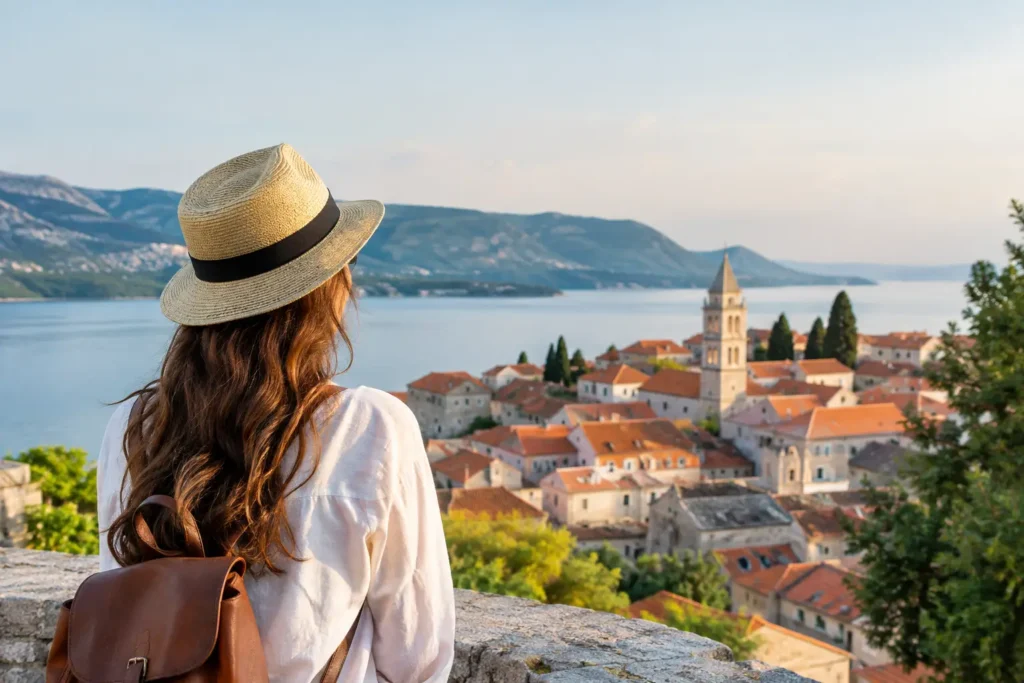
A name on an old passenger list can feel distant until you stand beneath the same stone church tower, hear a local pronounce the family surname, and look out across the harbor your ancestors once knew. This ancestral homecoming example follows an American family whose Croatian heritage became the heart of a private Adriatic journey – not a rushed search for records, but an experience designed around their story.
For travelers with roots in Croatia, Slovenia, or the wider Dalmatian cultural sphere, heritage travel is rarely about checking landmarks off a list. It is about making a place personal. The most memorable journeys allow room for discovery, including the possibility that family lore and local records may not match perfectly. That uncertainty is part of the experience. With thoughtful planning, it becomes an invitation to listen more closely.
An Ancestral Homecoming Example: The Maric Family
The Maric family came from three generations and two American cities, united by a shared question: what did their grandfather leave behind when he sailed from Dalmatia in the 1920s? They had a handful of clues: his birth village was believed to be near Split, an old black-and-white photograph showed him in front of a vineyard, and his surname appeared in a grandmother’s handwritten recipe book.
Rather than booking a standard coastal cruise and trying to arrange village visits along the way, the family chose a private itinerary shaped around those fragments. Their journey began in Split, where they spent two unhurried nights in a refined waterfront hotel. A private guide introduced the city through its layers of Roman, Venetian, and Croatian history, giving the family cultural context before the personal part of the journey began.
The next morning, a local heritage researcher joined them over coffee. She had reviewed parish records, immigration documents, and surname patterns in advance. Her work suggested that the family’s original village was not the one named in American documents, but a smaller settlement inland, where several Maric households appeared in records from the period.
That correction mattered. It was also handled with care. Family history is often a braid of fact, memory, altered spellings, and stories told across generations. A meaningful ancestral journey does not force a tidy answer. It follows the strongest evidence while honoring the story that brought the family there.
A village visit with time to belong
A private driver took the family through olive groves and low limestone hills to the village. There was no crowd, no fixed group schedule, and no pressure to turn an emotional moment into a quick photograph. Their guide had arranged a meeting with a local historian, who walked with them through narrow lanes and pointed out the former schoolhouse, the parish church, and the terraced fields that had supported local families for centuries.
At the church, the priest opened a parish register containing a familiar surname. The entry did not provide a dramatic revelation. It confirmed a birth date that was already suspected and identified the family home by an old local designation. Yet the moment was profound. The youngest members of the Maric family watched their mother trace a line of ink written more than a century earlier.
Lunch followed at a family-run konoba, where the menu reflected the region rather than a tourist script: local olive oil, grilled fish, garden vegetables, and a wine poured by the owner. Conversation moved from genealogy to everyday life – weddings, harvests, emigration, and the relatives who remained. This is where an ancestral visit becomes more than research. It becomes a human connection.
Why a Heritage Journey Needs More Than a Village Stop
An ancestral homecoming should have emotional space around it. Arriving by private vehicle, with a trusted local guide and no need to navigate unfamiliar roads, allows travelers to be present rather than preoccupied. For some families, the right pace is a half-day visit followed by a quiet afternoon at sea. For others, it means spending a night nearby, returning to the village the next morning, or meeting more than one branch of the family.
The Marics chose to continue their journey aboard a private yacht, departing from Split after their village visit. The transition was intentional. After a morning filled with memory and discovery, they had the privacy of the Adriatic to absorb it all. Lunch on deck became an opportunity for grandparents to share stories that had never been written down. Their adult children asked questions they had not thought to ask before. The grandchildren, who had initially been most excited about swimming from the yacht, began using Croatian place names with real familiarity.
Their route included Hvar, Vis, Korcula, and Dubrovnik, but the itinerary was never simply about famous islands. Each stop was curated around the family’s interests. In Hvar, they visited a small winery with deep regional roots. On Vis, they explored a fishing village at a gentler pace. In Korcula, a private guide connected local maritime traditions to the emigration routes that had carried so many Dalmatian families to America.
Luxury, in this setting, was not excess for its own sake. It was the freedom to travel without compromise: the privacy to speak openly, the flexibility to stay longer when a place moved them, and the ease of having every detail handled with discretion.
What Makes an Ancestral Homecoming Feel Authentic
The best heritage itineraries balance preparation with openness. Before travel, genealogy research can help identify likely villages, parish archives, historic addresses, or living connections. But records may be incomplete, surnames may have changed, and political borders may have shifted over generations. A skilled planner sets expectations honestly and builds a journey that remains meaningful whether the research produces one definitive answer or several promising leads.
It also helps to distinguish between a confirmed ancestral site and a culturally resonant one. Perhaps the original family home no longer stands, or the village is difficult to access. A nearby town, a regional museum, a church archive, or a conversation with a local family bearing the same surname can still offer an authentic sense of place. The goal is not to manufacture a dramatic reunion. It is to create conditions for genuine connection.
For multigenerational groups, the itinerary should also honor different forms of belonging. One traveler may want time with documents and archival detail. Another may connect through food, music, coastal landscapes, or a cooking lesson based on regional dishes. A well-designed trip makes room for each person without diluting the central story.
Designing Your Own Return to the Adriatic
A personalized homecoming begins with what you already have: family names, approximate birthplaces, letters, photographs, immigration records, recipes, oral histories, and even uncertain memories. No detail is too small to share. A misspelled village name can point toward a phonetic American version of a Croatian place name. A photograph of a house may reveal a regional architectural style. A family story about traveling “near Split” may eventually lead to an island, a hillside hamlet, or a town beyond the coast.
From there, the experience can be built around your preferred level of privacy and comfort. Some travelers want a boutique ship journey with a small circle of family and a carefully paced land program. Others prefer a private yacht, a dedicated vehicle and driver on shore, and exclusive guides throughout. The right choice depends on the size of your group, the locations involved, and whether you want the journey to feel like a family gathering, a private retreat, or both.
Adriatic Roots Cruises approaches these trips as personal narratives, not fixed packages. The point is not merely to bring you to Croatia or Slovenia. It is to arrange the right sequence of moments: the archive before the village, the village before a long lunch, the emotional visit before an afternoon on the water.
When you return to the places that shaped your family, you may not find every answer. You may find something more lasting: a clearer sense of where your story began, and the time and comfort to carry it forward together.