A family name on an old immigration document can feel tantalizingly close to home, yet still leave you with one stubborn question: where, exactly, did they come from? For many Croatian-American families, the answer lies in parish registers. To trace ancestors through Croatian parishes is to move beyond a country of origin and toward a particular church, village, coastline, and community that shaped your family’s earliest story.
These records can be remarkably rich, but they are rarely simple. Borders changed, place names shifted between languages, and neighboring parishes sometimes recorded the same family in different ways. With thoughtful preparation and time on the ground, the search can become something far more personal than a research project: a return to the places your family once knew.
Why Croatian parish records matter
Before civil registration became widely established, Catholic parishes were often the essential recordkeepers of daily life in Croatia. Priests documented baptisms, marriages, and burials, frequently recording not only names and dates but also a family’s village, house number, parents, occupations, marital status, and godparents or witnesses.
Those supporting names can be the turning point. In a small Dalmatian island village, for example, the same surnames may appear repeatedly over generations. A baptismal sponsor might be a maternal uncle. A marriage witness may identify the branch of a family that remained in Croatia after others left for Pennsylvania, Illinois, California, or Argentina. The record is rarely a complete story on its own, but it can give your story its proper setting.
Parish research also provides a crucial level of precision. Croatia has many villages with similar or identical names, while an immigrant record may list only “Austria,” “Yugoslavia,” “Dalmatia,” or “Croatia” as a birthplace. Finding the parish helps distinguish one family from another and turns a broad regional connection into a place you can genuinely visit.
Start with the clue that identifies a parish
The most productive research begins at home, not in an archive. Collect every document available from the immigrant generation and the generation immediately before it. Naturalization files, passenger lists, death certificates, obituaries, grave markers, wedding announcements, family prayer books, and old letters may each preserve a spelling, village, or relative’s name that points in the right direction.
Look especially for a birthplace more specific than Croatia. A town, island, municipality, former county, or even an unfamiliar phrase copied from a ship manifest may be valuable. Do not discard a name simply because it seems misspelled. Clerks wrote what they heard, and immigrants often adjusted names after arriving in the United States.
It also helps to build a small family group before pursuing records. Record known birth dates, marriages, siblings, religious affiliation, immigration years, and names of close associates. A parish register may use a Latinized first name or a surname with a different ending, but the combination of a spouse, house number, and approximate age can confirm that you have found the right person.
Place names need historical context
A modern map is useful, but it is not enough. Croatian places may appear in Croatian, Italian, German, Hungarian, Latin, or older regional forms, depending on the year and the political administration. A coastal ancestor from the former Austro-Hungarian Empire may be listed under an Italian version of a village name, while a church record may be written in Latin.
The parish itself may also have belonged to a different diocese at different points in history. This is why an exact village is ideal, but a nearby town, island, or district can still provide a valuable starting point. The goal is not to force an immediate match. It is to test each clue against geography, chronology, and the family names that appear locally.
How to trace ancestors through Croatian parishes
Once you have a likely origin, identify the parish that served the village during your ancestor’s lifetime. The nearest church today is not always the correct one. Remote hamlets could be attached to a larger parish several miles away, and a growing settlement may have later formed its own parish. Local historical knowledge is often as important as a map.
The core registers are baptisms, marriages, and burials. Begin with the event nearest to a known date, then work outward through parents, siblings, and marriages. Baptismal entries generally help establish parentage; marriage records may supply ages, parents, birthplaces, and prior marital status; burial entries can clarify whether an individual remained in the village or died after a period of migration.
As you review entries, create a timeline rather than collecting isolated names. Notice recurring house numbers, witnesses, and godparents. In many communities, these details reveal relationships that are not explicitly written down. They also help distinguish between two men with the same name, a common challenge in villages where naming traditions repeated across generations.
Expect gaps. Some registers were damaged, moved, restricted, or never fully indexed. The absence of one record does not end the search. A sibling’s baptism, a parent’s marriage, a burial entry, or a later civil record may supply the missing link. Research rewards patience, especially when records span centuries and multiple administrations.
Reading the records without losing the human story
The language of a register can be intimidating, but most entries follow a dependable pattern. Latin is common in older Catholic books, while later records may appear in Croatian, Italian, German, or a combination. You do not need to be fluent in every language to recognize dates, familiar sacramental terms, and names, but careful interpretation matters.
Spelling should be treated as flexible. Diacritics may be omitted in American records, and names such as Ivan, Giovanni, Johann, and Ioannes can refer to the same person in different sources. Surnames may shift slightly through handwriting, grammar, or transcription. Rather than seeking an identical spelling, look for a consistent family cluster in the right place and period.
There is also a practical distinction between digital research and local access. Some parish records have been digitized or transferred to regional archives, while others remain with parishes, diocesan archives, or municipal institutions. Access policies vary. A parish is an active spiritual community, not simply a repository, so requests should be respectful, specific, and mindful of staff time and privacy rules for more recent records.
Turn research into a journey through your roots
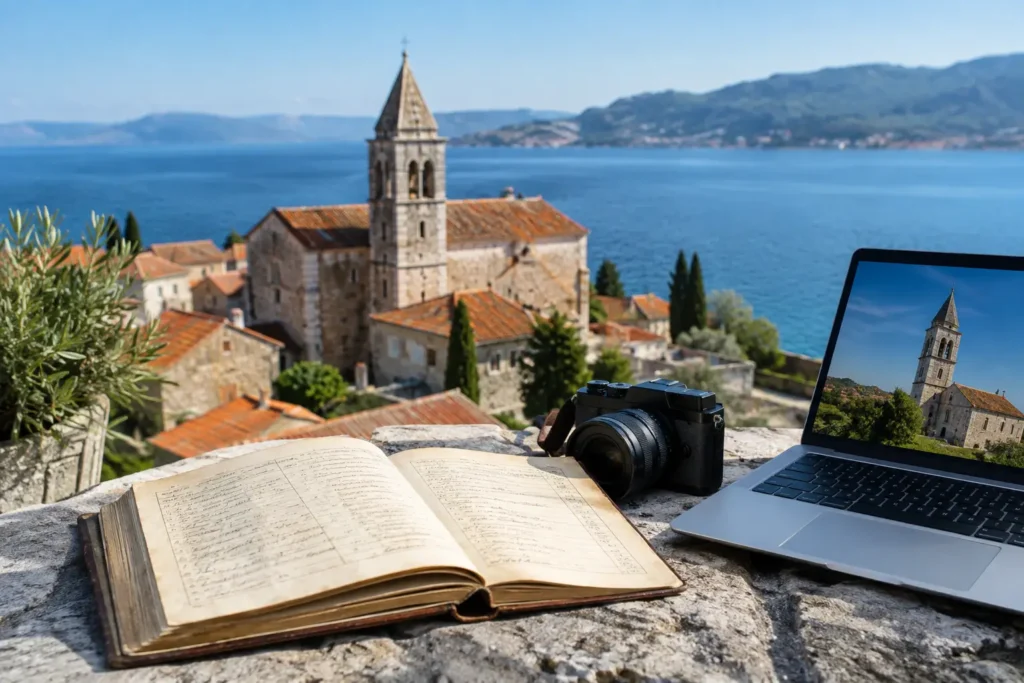
A parish record becomes more meaningful when you stand in the village where it was created. You may see the church tower your ancestors saw, walk a harbor road where departing relatives began their journey, or share a meal with residents who recognize a surname still present in the area. These moments cannot be guaranteed, but they are often the most lasting part of heritage travel.
For a family visiting Croatia by private yacht or boutique ship, parish exploration can fit naturally into a broader Adriatic itinerary. A day ashore might begin with a private guide in an ancestral village, continue with a visit to the parish church or local cemetery, and end with a long coastal lunch featuring regional dishes your family may have known by another name. On an island, the pace can be especially moving: the sea that once separated a community from the mainland becomes part of the story of why people left and how they stayed connected.
The best itinerary allows room for both certainty and discovery. If research identifies a precise church, a visit can be planned around that location and the local archive schedule. If the evidence points only to a region, the journey can focus on the landscapes, ports, cuisine, and historic communities that frame the family’s likely experience while further research continues.
What to bring to your ancestral village visit
Bring copies of the documents that led you there, including names in every spelling you have found. A simple family tree, old photographs, and dates of birth or marriage can help a local guide, parish representative, or distant relative understand the connection quickly. It is wise to carry both printed copies and digital backups, particularly in small communities where cell service can be uneven.
Most of all, arrive with curiosity rather than a fixed expectation. A church may be closed for restoration, the original home may no longer stand, or a parish record may confirm a detail that changes the family narrative. Those outcomes are not disappointments. They are part of meeting the past honestly, in the place where it happened.
A carefully planned roots journey leaves room for that honest encounter. Whether your family’s trail leads to a stone church above the Dalmatian coast, a hillside parish in inland Croatia, or a quiet island cemetery, the destination is not merely an address in a register. It is a chance to let your family history become a living part of your own.