A faded surname on a ship manifest. A photograph with a village name written in careful pencil. A family recipe that has crossed an ocean but lost its original context. To plan a Croatian family heritage trip is to give those fragments a place on the map – and, often, a deeper meaning.
For families with Croatian roots, this is not simply a vacation through beautiful coastal towns. It is an opportunity to stand where a grandparent once walked, hear a local pronunciation of a family name, share a long lunch in the region that shaped your story, and bring several generations together around something more lasting than a sightseeing itinerary.
The most meaningful journeys balance emotion with thoughtful planning. Croatia’s islands, historic cities, and inland villages are remarkably varied, and ancestral places are not always close to the country’s best-known ports. A carefully designed land-and-sea itinerary allows room for both: the private, personal moments and the exceptional Adriatic experience around them.
Begin with the story you already have
You do not need a complete family tree before you begin. In fact, many heritage journeys start with only a surname, a birthplace listed as “Dalmatia,” an old letter, or the memory of a relative saying they came from near Split, Šibenik, Korčula, or the islands.
Gather what your family holds first: full names, maiden names, dates of birth, baptismal records, immigration documents, old passports, obituaries, military papers, photographs, and handwritten addresses. Even small details can be useful. A parish name may point more precisely to a village than a county listed on an American record. A family nickname can help distinguish one branch from another in a small community where names repeat across generations.
It is equally helpful to ask relatives what they remember before the trip becomes imminent. Record their stories, including the uncertain ones. Was the family from an island or the mainland? Did they speak of vineyards, fishing, stone houses, or a patron saint’s feast day? These recollections may not always be exact, but they often provide the texture that turns research into a personal journey.
Know the limits of records
Genealogy in Croatia can be wonderfully revealing, but it is not always immediate. Borders, place names, languages, and administrative systems changed over generations. A town may have been recorded under an Italian, German, Hungarian, or historic regional spelling, depending on the period. Some records are held by parishes, municipalities, archives, or family members rather than in a single searchable database.
That is where local expertise matters. A genealogy specialist or well-connected regional guide can help interpret the clues, identify the correct village, and set realistic expectations. Sometimes a family connection can be documented with precision. Other times, the reward is a carefully researched encounter with the landscape, customs, and community from which your family emerged. Both can be profoundly moving.
Plan a Croatian family heritage trip around place, not a checklist
A generic route may move efficiently from Dubrovnik to Split to Hvar, but heritage travel asks a different question: where does your family story lead?
If your ancestors came from a coastal village or island, a private yacht or boutique vessel can create an elegant and flexible base. You might sail from Split to Brač, Hvar, Vis, Korčula, or the Elaphiti Islands, with private transfers arranged for village visits, parish appointments, and time with local hosts. Returning to the water after an emotional day on land brings a welcome sense of privacy and calm.
If your roots are inland, the itinerary may begin with a few nights in Zagreb, Istria, or the Dalmatian hinterland before joining a coastal cruise. The best route depends on distance, road conditions, the ages and interests of your travelers, and how much time you want to spend in each meaningful place. There is little value in rushing through an ancestral village simply to keep pace with a standard sailing schedule.
For many families, seven to 10 nights provides enough time to combine heritage visits with restorative travel. A longer itinerary may be worthwhile when relatives are spread across multiple regions, when research requires flexibility, or when the trip includes Slovenia as part of a broader family story.
Make room for the moments that cannot be scheduled
Heritage travel needs structure, but it should not feel overproduced. The most memorable moments are often the ones that arise when there is time to linger.
That could mean sitting with a local historian who recognizes a surname, visiting a cemetery where generations of a family are buried, or accepting coffee from a distant cousin who has opened a photo album at the kitchen table. It may be as simple as walking a narrow lane, looking at the stonework, and realizing that the view your grandmother described was real.
Build unhurried time into the itinerary after a village visit or family meeting. Schedule a private lunch featuring regional dishes, a wine tasting with a local producer, or a quiet afternoon aboard your vessel. These pauses allow everyone to process what they have experienced, especially when grandparents, adult children, and younger family members are traveling together.
There is also a practical reason to remain flexible. Parish offices may have limited hours. A local contact may only be available on a certain day. Weather can affect island crossings. A bespoke itinerary can adjust without asking your family to sacrifice the heart of the trip.
Pair ancestral places with Croatia’s cultural riches
Your family’s village is the emotional center, but it is part of a larger cultural world. Croatia’s heritage is expressed in Roman cities, Venetian ports, centuries-old monasteries, family-run konobas, olive groves, and the distinct traditions of every island and region.
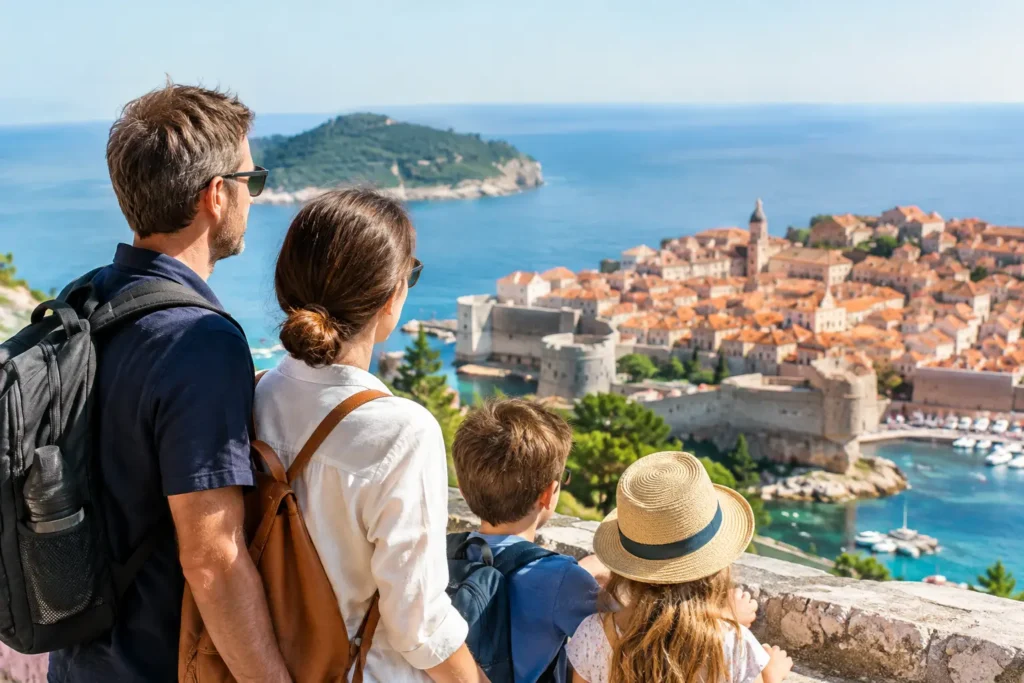
A thoughtfully layered journey might begin with a private walk through Diocletian’s Palace in Split, then continue to a family village in the Dalmatian interior. It could pair an ancestral visit on Korčula with a small winery lunch and an evening anchored in a quiet bay. In Dubrovnik, a private guide can offer historical context that helps explain the migration patterns, trade routes, and political changes that influenced generations of Adriatic families.
These experiences should support the story rather than distract from it. Luxury is not only about a beautiful cabin, a polished transfer, or a celebrated restaurant. It is the ease of knowing that every detail has been considered, so your family can be present for what matters.
Design for every generation at the table
A heritage trip can be especially powerful as a multigenerational experience, but each traveler will connect differently. A grandparent may be focused on remembrance. Adult children may want to understand identity and preserve family stories. Teenagers may respond most strongly to swimming from the yacht, learning to cook a regional dish, or meeting someone their own age in the ancestral community.
The answer is not to divide the journey into separate vacations. It is to create a rhythm that respects everyone. A morning of family-history discovery can lead into an afternoon on the water. A guided city visit can be followed by independent time for shopping, swimming, or a spa treatment. Private travel makes this easier because the pace belongs to your family, not to a group departure.
Consider one meaningful shared ritual during the journey. It might be a dinner where each person shares a family memory, a toast in the village of origin, or a small collection of copied photographs and stories presented to the youngest generation. These details need not be elaborate. Their value lies in making the experience part of your family’s living legacy.
Choose partners who can handle both the personal and practical details
The difference between a pleasant Croatian holiday and a true heritage journey is often found behind the scenes. It takes careful coordination to arrange private access, communicate with local contacts, translate names and records, select accommodations that suit your family, and shape a route that feels effortless rather than crowded.
At Adriatic Roots Cruises, each itinerary is designed around the family at its center – from discreet genealogy support and ancestral village visits to private cruising, exceptional dining, and guides who understand the cultural nuances of the region. The goal is never to force your story into a predetermined route. It is to create a journey with the comfort, privacy, and care that such a personal return deserves.
Begin with what you know, allow room for what you may discover, and let the Adriatic become more than a beautiful backdrop. It can become the setting where your family’s past feels close enough to touch – and where a new chapter is shared together.