The first notes of a klapa song drifting over a Dalmatian harbor can feel less like a performance than a shared memory. This guide to Croatian folk traditions is for travelers who want to move beyond postcard moments and understand the customs that still shape village life, family celebrations, island identity, and the rhythms of the Adriatic coast.
Croatian tradition is not one fixed pageant. It changes from region to region, and often from one island, town, or family to the next. The most meaningful encounters come from approaching these customs with curiosity rather than expecting a staged spectacle. A private visit to an ancestral village, a meal prepared in a family home, or an evening festival timed to a local saint’s day can reveal far more than a crowded performance ever could.
A Guide to Croatian Folk Traditions by Region
Croatia’s compact geography holds a remarkable range of cultural worlds. Coastal Dalmatia carries Venetian, Roman, Slavic, and maritime influences. Inland regions preserve different musical forms, dress, foods, and seasonal rituals. For families tracing a surname or village, these distinctions can add texture to a story that once existed only in old documents.
Dalmatia: Song, stone, and the sea
Along the Dalmatian coast and islands, klapa singing is among the traditions visitors remember longest. Usually performed a cappella by a small group, klapa centers on close harmonies and songs of love, the sea, home, and longing. It can be formally presented at a concert, but its real intimacy is felt in a town square after dinner or during a local celebration, when the voices rise without much ceremony.
Dalmatian life is also marked by the calendar of patron saints. Processions, church bells, decorated boats, and family tables come together for feast days in places such as Split, Hvar, Korčula, and smaller villages. The experience depends on timing. A summer visit may offer public festivities and warm evenings outdoors, while a quieter shoulder-season journey can allow more personal conversations with local hosts.
On Korčula, the Moreška sword dance is a vivid example of a tradition with deep local roots. Its choreographed battle, costumes, and music make it visually striking, yet the fuller story lies in its connection to the town’s identity and the generations who have kept it alive. It is best appreciated as a living civic tradition, not simply an item to check off an itinerary.
Istria and Kvarner: Earthy flavors and distinct voices
Istria’s traditions are shaped by hill towns, olive groves, truffle country, and a history of cultural exchange across the northern Adriatic. Food is often the most immediate doorway: handmade pasta, olive oil, wine, wild asparagus in spring, and truffles when the season is right. A private cooking experience can be especially rewarding here because it places recipes in the context of family, landscape, and harvest.
Istrian traditional singing and playing have a sound unlike Dalmatian klapa. The tonal style can seem unusual to ears accustomed to Western harmonies, which is part of its power. Rather than judging it by familiarity, listen for the way it belongs to the region’s language, terrain, and communal life.
The Kvarner islands and coast add their own maritime customs, carnival traditions, and island-specific dialects. If your family roots lead to Krk, Cres, Lošinj, or Rab, local guides can help distinguish a broad regional identity from the customs particular to the village your ancestors called home.
Slavonia, Zagorje, and inland Croatia: Hospitality at the table
Inland Croatia offers a different pace and palette. Slavonia is known for fertile plains, tamburica music, paprika-rich dishes, and generous hospitality. The tamburica, a family of stringed instruments, accompanies songs and gatherings with a bright, spirited sound. Traditional celebrations may include embroidered dress, dancing, and foods that reflect the agricultural year.
In Hrvatsko Zagorje, north of Zagreb, folk culture often feels closely tied to vineyards, village churches, and home cooking. Štrukli, a baked or boiled pastry filled with fresh cheese, is a beloved regional dish. More than a recipe, it is the kind of food that invites a story about a grandmother’s kitchen, a wedding feast, or the care involved in feeding a full family table.
Traditions That Carry Family Memory
For heritage travelers, folk traditions are often most moving when they illuminate the life behind a family record. A baptismal certificate may name a parish, but a visit can reveal the church bells that marked daily life. A surname may point to an island, while local songs and fishing customs explain why so many residents eventually left for America, Australia, or South America while carrying their homeland with them.
Several traditions are especially valuable for this kind of connection:
- Family feasts and saint’s days can show how faith, food, and kinship remain closely intertwined.
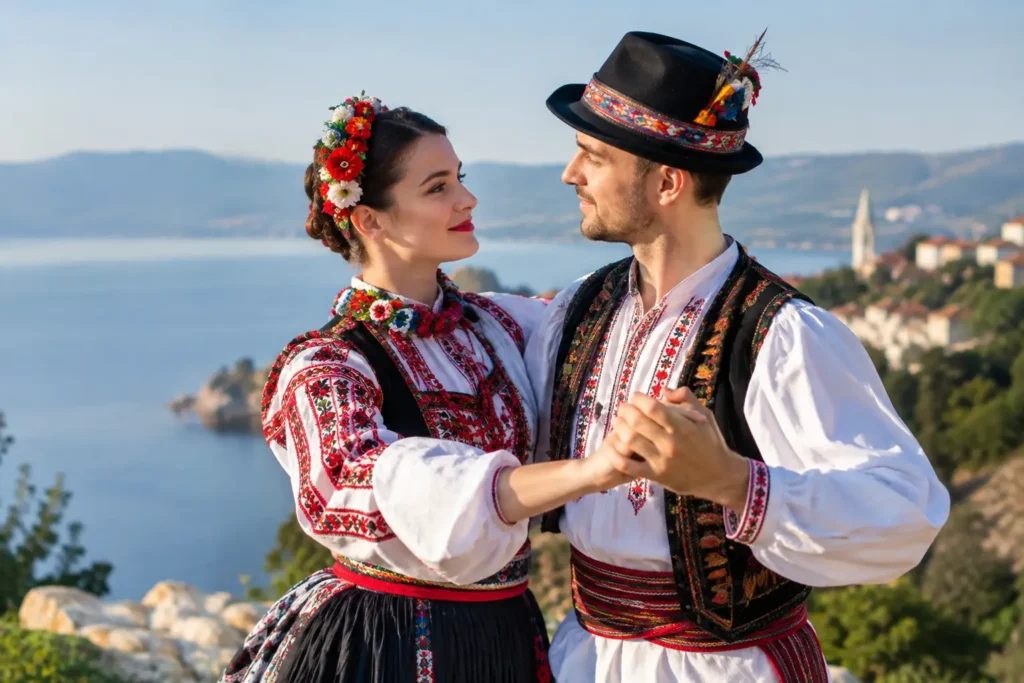
- Traditional dress reflects local materials, marital status, craft skills, and regional pride. It is often worn for festivals rather than everyday life.
- Folk dance preserves social patterns as much as choreography, from courtship rituals to community celebration.
- Handcrafts such as lace, embroidery, woodwork, and ceramics offer a tangible link to the work once done in households and villages.
The right experience should be shaped around your own story. A traveler with roots on Hvar may be drawn to island church customs and maritime songs, while a family connected to Slavonia may find greater meaning in tamburica music, harvest traditions, and a long lunch in the countryside. Neither is more authentically Croatian. They are simply different expressions of belonging.
How to Experience Croatian Traditions Respectfully
The most memorable cultural experiences require a little grace from the visitor. Croatia welcomes guests warmly, but traditions are not props. A procession may be a sacred event before it is a photograph. A family recipe may be offered as hospitality, not as entertainment. The distinction matters.
Dress thoughtfully when entering churches or attending religious events, especially in smaller communities. Ask before photographing people in traditional costume, musicians, or private homes. If you are invited to share food or wine, accept what feels comfortable and offer genuine interest in the person who prepared it. A few Croatian words, even a simple hvala for thank you, are always appreciated.
It also helps to avoid treating every custom as ancient and unchanged. Croatian culture is alive. Young musicians reinterpret old songs, families adapt celebrations to modern schedules, and towns balance local pride with tourism. That evolution does not diminish tradition. It shows that the tradition still matters.
Building a Journey Around the Cultural Calendar
Timing can transform a well-planned trip. Summer brings outdoor festivals, patron-saint celebrations, and lively waterfront evenings, but also more visitors. Spring and fall are often ideal for travelers seeking a more unhurried rhythm, with food traditions, harvests, and easier access to intimate local experiences. Winter can suit those interested in Advent customs, carnival, or a quieter heritage visit, though some coastal properties and island services operate on reduced schedules.
A private Adriatic cruise offers a particularly graceful way to connect coastal traditions without rushing from hotel to hotel. You might begin with a private guide in Split, hear klapa in a historic setting, spend the next day visiting a family village on Brač, then continue to Korčula for an evening shaped around its local history. The luxury is not only in the yacht, the accommodations, or the service. It is in having the time and access to let each place speak in its own voice.
For a multigenerational family, consider pairing public cultural events with private moments. Children may remember a dance performance or a boat procession, while parents and grandparents may treasure the quieter visit to a parish, cemetery, or ancestral home region. A thoughtfully paced itinerary gives both experiences room to matter.
Let Tradition Be Personal
The finest cultural travel does not ask you to consume a country in a week. It invites you to notice what lingers: the harmony of voices in a stone lane, the pattern of lace made by patient hands, the welcome at a table where a family recipe has outlasted borders and migrations.
When planning your Croatian journey, leave space for those unscripted encounters. They are often where heritage becomes personal, and where a beautiful trip becomes part of your family’s own continuing story.