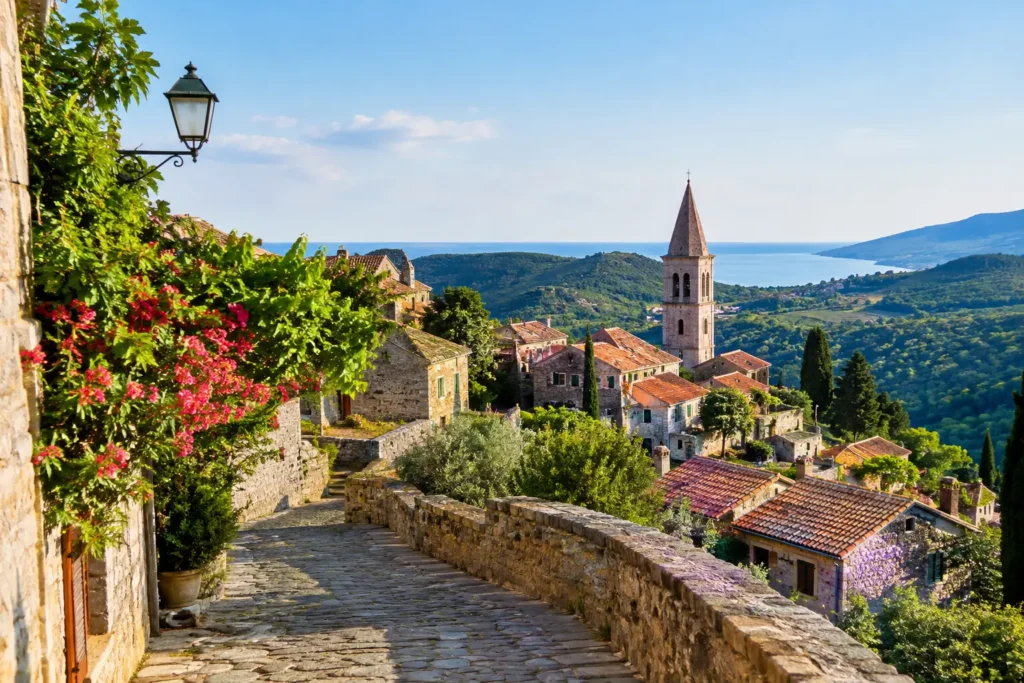
A true guide to historic Istrian villages begins where the larger roads narrow: beneath cypress trees, past vineyards and stone walls, and into settlements that have held their shape for centuries. In Istria, a village visit can be far more than a picturesque afternoon. For travelers with Croatian, Slovenian, Italian, or Austro-Hungarian family connections, it can become a rare encounter with the landscape that formed a family story.
This is a peninsula of layered identities. Borders shifted, languages overlapped, and surnames were often recorded differently from one generation to the next. The reward for approaching Istria with care is not simply beautiful architecture, though there is plenty of it. It is the feeling of standing in a hilltop square, hearing church bells cross the valley, and recognizing that history here is still intimate.
Why Istria’s Villages Feel So Personal
Istria is divided among Croatia, Slovenia, and Italy, with the Croatian interior offering the greatest concentration of preserved medieval hill towns. Many sit above the Mirna River valley or among the limestone hills inland from the Adriatic. Their narrow lanes, Venetian lions, parish churches, and weathered stone facades tell a story of Roman foundations, Venetian rule, Habsburg administration, and enduring local life.
For heritage travelers, that complexity matters. An ancestor may have described themselves as Italian, Croatian, Slovenian, or Istrian depending on the era, language of record, and political border in place at the time. A carefully designed visit makes room for these realities rather than flattening them into a single narrative.
The villages also offer a welcome counterpoint to the coast. After a private cruise along the Adriatic or a stay in Rovinj, Pula, or Opatija, the interior changes the rhythm. The days become quieter and more grounded: a conversation with a local guide, a lunch centered on truffles or seasonal wild asparagus, a stop at a family-run winery, and time to linger where your history invites you.
The Historic Istrian Villages to Know
Motovun: The Iconic Hilltop Setting
Motovun rises dramatically above the Mirna Valley, its ramparts encircling a compact old town with far-reaching views over forests, vineyards, and truffle country. It is one of Istria’s most recognizable villages, and for good reason. Walking its walls gives a sense of the strategic importance these hill settlements once held.
Motovun is ideal for travelers who want an elegant introduction to inland Istria. Its popularity means it can feel busy in the middle of summer, so timing is everything. An early private visit, followed by a long lunch in the valley or a truffle-focused experience, offers a more considered way to experience it.
Grožnjan: Art, Stone, and Quiet Lanes
Grožnjan, known in Italian as Grisignana, has a softer, more artistic character. It is filled with studios, galleries, shutters, and lanes that seem designed for unhurried wandering. In summer, music and art programs bring the village to life; outside peak season, it can feel almost suspended in time.
For families tracing roots, Grožnjan is especially compelling when a surname, parish, or nearby hamlet provides a specific reason to visit. A local historian can place the village within the region’s Italian-speaking, Croatian-speaking, and multilingual past, adding context that a self-guided walk rarely provides.
Oprtalj: A Village with a Sense of Stillness
Oprtalj is less polished than Motovun and often more affecting because of it. Perched above the Mirna Valley, it has worn stone portals, small chapels, and a quiet, lived-in atmosphere. This is the sort of place where the details matter: an old inscription above a doorway, the way the road bends toward the parish church, the names on a cemetery wall.
It is a strong choice for travelers who value atmosphere over a checklist. Pair it with nearby villages and an intimate tasting rather than trying to cover too much ground in one day.
Hum: Small in Scale, Rich in Tradition
Hum is often described as one of the world’s smallest towns. The designation makes for an appealing story, but its real pleasure is its compactness. Within a short walk are medieval gates, a parish church, stone homes, and a palpable sense of continuity.
Hum works beautifully as one moment within a fuller inland route, particularly alongside Roč and the Glagolitic heritage sites of central Istria. The Glagolitic script, used historically by Slavic communities in the region, adds another layer for travelers interested in language, faith, and cultural identity.
Bale and Svetvinčenat: Graceful Alternatives Near the Coast
Not every meaningful Istrian village sits high above a valley. Bale is a handsome stone town near the western coast, with a refined, restrained character and easy access from Rovinj. Svetvinčenat, farther inland, is centered on a striking Renaissance square and the Morosini-Grimani Castle.
Both are excellent choices for a family group that wants heritage texture without an extended drive into the northern interior. They also fit naturally into a day that includes a private coastal excursion, a gourmet lunch, or an evening return to a yacht or boutique hotel.
How to Build a Meaningful Istrian Village Day
The most rewarding village days are designed around a purpose. If your goal is visual discovery, a route through Motovun, Grožnjan, and Oprtalj can reveal three distinct personalities in one well-paced day. If your goal is ancestral research, the route should begin with records, locations, and realistic expectations.
A village named in a family document may no longer use the same spelling. A parish register may be held in another town, an archive, or a diocesan collection. The ancestral home itself may have been rebuilt, renumbered, or remain privately occupied. These are not disappointments when anticipated – they are part of the honest work of reconnecting with a place.
A private guide and driver make a significant difference here. Istria’s roads are scenic but winding, parking can be limited in historic centers, and meaningful sites are often easy to miss without local knowledge. More importantly, a guide can create the conditions for respectful connection, whether that means arranging a parish visit, interpreting an inscription, or simply allowing enough unstructured time to absorb what you have found.
A More Thoughtful Approach to Heritage Visits
When family history is central to the journey, begin planning well before arrival. Gather names, alternate spellings, birth dates, marriage records, photographs, letters, and the most precise village references available. Even a faded address or a remembered patron saint can offer useful clues.
Then leave room for uncertainty. Genealogy is rarely linear in Istria, where emigration, war, changing administrations, and multilingual recordkeeping shaped many families. The goal is not to force a perfect answer from every stop. It is to bring your own story into conversation with the region’s deeper history.
For multigenerational travelers, this approach is particularly powerful. Grandparents can share what they know while younger family members experience the place itself: the scent of rosemary on warm stone, the ritual of a village coffee, the view from a bell tower, and a table set with local olive oil, cheese, wine, and bread. Those details often become the memories that endure.
When to Visit the Villages of Istria
Late April through June and September through October are often the most comfortable times for village exploration. The light is beautiful, temperatures are pleasant for walking, and the roads are generally less crowded than in the height of summer. Autumn also brings truffle season, making the inland villages especially appealing for travelers who value food as part of cultural connection.
July and August can still be wonderful, particularly when paired with time on the water, but village visits should be scheduled early or later in the afternoon. Winter offers a quieter, more introspective atmosphere, though some restaurants, galleries, and smaller properties operate on limited hours.
A custom journey with Adriatic Roots Cruises can connect these inland days to a private Adriatic itinerary, balancing polished comfort with the places that make a family story feel real. The most memorable route is rarely the one that sees the most villages. It is the one that gives you time to recognize why one particular church, street, or hillside matters to you.
Let Istria unfold at its own pace. Somewhere beyond the postcard views, a village may offer not just a beautiful stop, but a more personal sense of where your story began.