A faded surname in a family Bible can lead to a village you have never seen, a church register written in a hand you cannot read, and a reading room holding records that turn family lore into something tangible. So, can Americans visit Croatian archives? Yes. American visitors are generally welcome to use Croatian archives, provided they follow each institution’s registration, identification, access, and handling rules.
For travelers tracing Croatian roots, an archive visit is rarely just an administrative stop between coastal excursions. It can be the quiet center of the journey: the moment a great-grandmother’s birthplace becomes a real street, parish, and community. The experience is far more rewarding when it is planned with the same care as a private cruise, a family gathering, or a stay in a historic Adriatic town.
Can Americans Visit Croatian Archives Without Special Permission?
In most cases, American citizenship does not create a barrier to visiting Croatian archives. Public archives serve researchers from Croatia and abroad, including genealogists, historians, students, and families seeking their own records. You will usually need a valid passport or other photo identification to register as a reader, and some institutions may ask you to complete a short application or agree to reading-room rules.
The practical answer depends on what you hope to see. Many historical records can be consulted in person, but access is not automatic simply because a document exists. Recent civil records may be protected by privacy rules. Fragile originals may be unavailable for handling if a microfilm copy, digital image, or conservation restriction applies. Some materials are stored off-site and require advance retrieval.
Think of an archive visit as an appointment with your family’s past, not a walk-in museum experience. A little preparation protects both your time and the records themselves.
Which Croatian Records May Help Your Family Search?
Croatia’s archival landscape is broad, and the right repository depends on your family’s place, faith, time period, and the record you need. The Croatian State Archives in Zagreb holds nationally significant collections, while regional and city archives preserve local administrative, legal, land, school, military, and community records. A family from Split, Dubrovnik, Rijeka, Osijek, or a small inland village may be represented in a different institution altogether.
For genealogy, parish registers are often the most sought-after source. Baptisms, marriages, and burials can reveal maiden names, household connections, occupations, godparents, and the villages that linked one branch of a family to another. Yet not every parish register is held in a state archive. Depending on the location and period, records may remain with a parish, a diocesan archive, or another church repository.
Civil registration records can also be invaluable, particularly for births, marriages, and deaths in more recent generations. Land records, probate files, military documents, passenger records, local censuses, and court papers may add texture to the story. A record that identifies an ancestral house, field, trade, or witness can transform a name on a chart into a person who belonged to a particular landscape.
Historical borders matter. Parts of present-day Croatia were once administered under the Habsburg Monarchy, Italy, Hungary, Yugoslavia, or other governing systems. That means records may appear in Croatian, Latin, Italian, German, Hungarian, or older scripts. The archive you need may also be determined by historical jurisdiction rather than the modern county name your family uses today.
Prepare Before You Enter the Reading Room
The most successful archival days begin weeks, sometimes months, before arrival. First, organize what you already know: full names, alternate spellings, approximate dates, religion, emigration details, village names, and any family documents. Even a clue such as “near Šibenik” can be useful, but a precise town or parish is much more powerful.
Names deserve special attention. Croatian surnames often appear with spelling variations in American documents, and immigrants sometimes simplified or translated their names after arrival. Diacritical marks may have been dropped. A surname remembered one way in Chicago or Pittsburgh may appear differently in a Croatian register. Search with flexibility, but do not assume that every similar name belongs to your family.
Contact the archive before you travel. Explain that you are visiting from the United States, state the records or family names you hope to research, and ask about registration, appointments, photography, retrieval times, fees, and language assistance. A concise request is more useful than a broad appeal for “everything about my family.” Include dates and locations wherever possible.
If the archive confirms that requested materials are available, ask whether they can be reserved in advance. This is especially valuable when your time in Croatia is limited by a carefully arranged land-and-sea itinerary. Some archival materials are delivered only at set times, and others may not be available on the day you arrive.
What to Expect During an Archive Visit
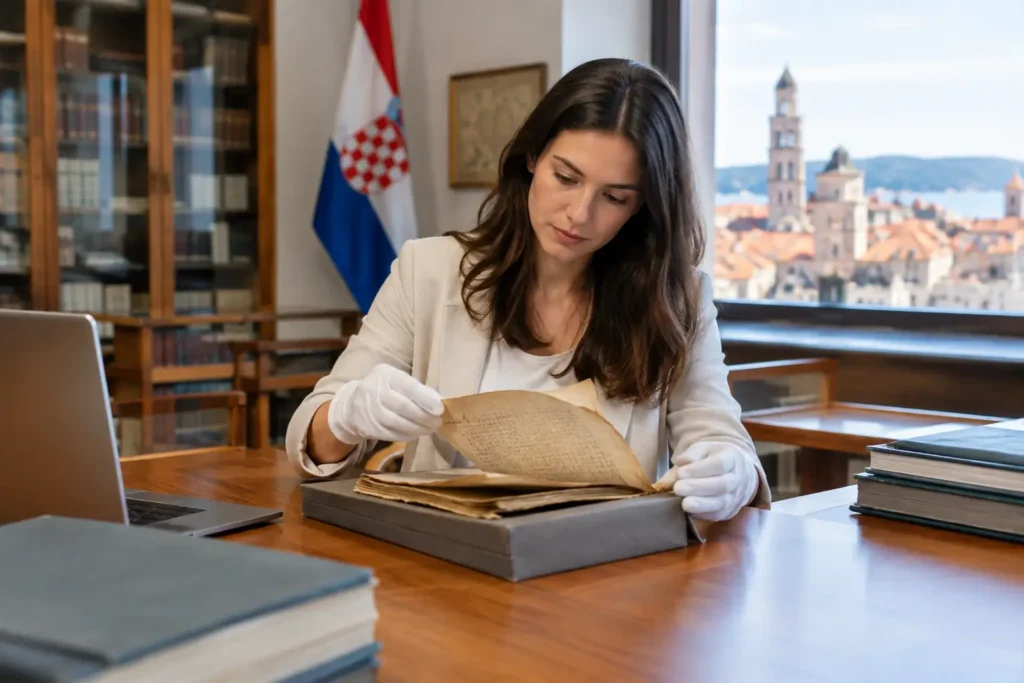
Croatian archives are working research institutions. Their rhythm is deliberate, respectful, and often quieter than visitors expect. You may be asked to leave coats, bags, food, and drinks in a locker before entering the reading room. Pencils rather than pens are commonly required. Staff may provide book supports, weights, or other tools to protect bound volumes.
Photography policies vary. Some archives allow personal reference photographs without flash; others charge a reproduction fee, limit photography, or require a formal request for scans. Never assume that a document can be photographed, published, or shared online simply because you can view it. Copyright, privacy, and preservation rules still apply.
Research also takes patience. A promising volume may contain several communities, use unfamiliar abbreviations, or be arranged by an old administrative system. The record you seek may not appear under the exact date you expected. This is where a knowledgeable local researcher, translator, or guide can make a meaningful difference. They do more than translate words. They understand the local geography, historical naming patterns, and the difference between a parish, municipality, hamlet, and ancestral village.
Privacy Rules and Records You May Not Be Able to See
Family history research can feel deeply personal, but archives must balance that interest with the privacy of living people. Records involving more recent births, marriages, deaths, adoptions, court matters, health, or personal files may have restricted access. The exact rules depend on the type of record and the institution holding it.
If a record is restricted, do not interpret that as a closed door to your larger search. An archive may be able to provide general guidance, point you toward an older record series, or explain what proof of relationship is needed for a formal request. In some cases, a certified copy must be requested through a civil registry office rather than viewed in an archive reading room.
Church and diocesan collections may have their own procedures as well. A parish priest or diocesan archivist may welcome a respectful inquiry, but access can depend on staffing, conservation conditions, and religious schedules. Courtesy matters. These are not merely records offices; they are often custodians of a living community’s history.
Build the Archive Into a More Meaningful Croatian Journey
The archive is only one chapter of a roots-based visit. Once a document identifies a village, parish, or family property, the journey can move beyond the page. You might walk the churchyard where generations were baptized and buried, meet a local historian, share a meal in the region your family left behind, or visit the harbor from which relatives began their passage to America.
This is where unhurried, customized travel has real value. Rather than compressing research into a rushed morning between standard sightseeing stops, leave room for discoveries. A newly found maiden name may lead to another village. A land record may shift the focus from an island to the mainland. A family story may deserve an extra afternoon in a place that suddenly feels familiar.
Adriatic Roots Cruises can weave archival research, ancestral village visits, private guides, and refined Adriatic travel into one journey designed around your story. The goal is not to make the past feel distant and academic. It is to give your family the time, comfort, and context to encounter it personally.
Bring your questions, but leave room for the unexpected. In a Croatian archive, the most moving discovery is often not the document you planned to find, but the small detail that helps you recognize where your story truly began.