The most memorable Croatian cruises are not measured only by the islands you visit or the clarity of the water outside your suite. They are measured by the moment a family name becomes a place on a map, when a village church ledger reveals a familiar surname, or when three generations share dinner overlooking the harbor where their story began.
For travelers with Croatian, Slovenian, or Dalmatian roots, the Adriatic offers far more than a beautiful coastline. It offers a rare way to travel between the landscapes of your heritage in privacy and comfort, while leaving room for the discoveries that cannot be scheduled on a standard cruise itinerary.
Why Croatian Cruises Feel Different When They Are Personal
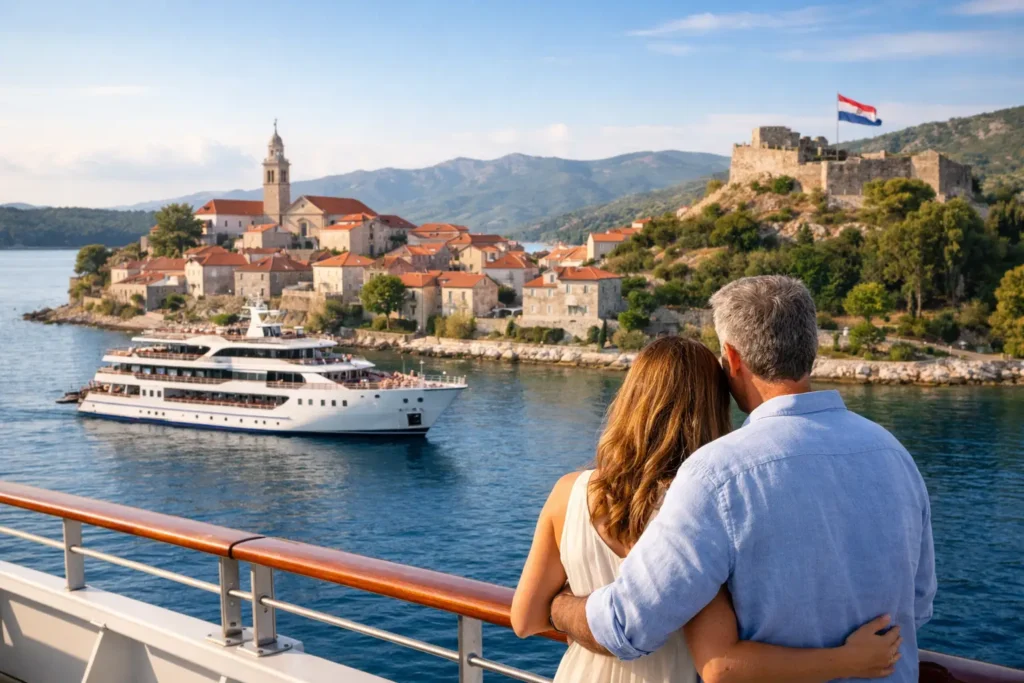
Croatia’s coast is made for intimate cruising. More than a thousand islands, sheltered channels, historic ports, and small fishing communities create an itinerary that can be fluid rather than fixed. A private yacht or boutique vessel can bring you close to Hvar’s stone lanes, Korčula’s vineyards, the quiet coves of the Šibenik archipelago, and the old walls of Dubrovnik without requiring you to return each evening to a large ship’s timetable.
That freedom matters most when the journey includes heritage. An ancestral village may be inland, a cousin may be available for lunch only on a particular day, or a local historian may recommend a detour to a parish that holds family records. On a custom journey, the cruise is not separate from the land experience. It becomes the elegant, unhurried thread connecting the places that matter to you.
There is also a practical advantage. The Adriatic’s coastal geography makes it possible to pair refined time at sea with meaningful private touring ashore. You might begin in Split, spend a morning with a guide in Diocletian’s Palace, then sail toward Brač before continuing inland to a family village near Imotski or Sinj. The next day can bring a quiet swim from the yacht, followed by a private olive oil tasting hosted by a local producer. The rhythm is yours.
Private Yacht or Boutique Ship: Choosing the Right Experience
The right vessel depends less on what is considered most luxurious and more on how you wish to travel. A private yacht offers complete privacy, exceptional flexibility, and the ability to shape days around your own pace. It is especially well suited to couples, families, and close groups who value time together without other guests around them.
A boutique ship can be an excellent choice for travelers who enjoy a more social atmosphere while still wanting a polished, small-scale experience. These vessels typically offer comfortable cabins, attentive service, and access to ports that larger cruise ships cannot reach. For some multigenerational groups, chartering a boutique ship creates an appealing balance: everyone has private space, yet the experience remains fully centered on the family.
Neither option is automatically better. A yacht may be ideal for a family reunion of eight who want complete control of the itinerary. A boutique charter may make more sense for a larger gathering celebrating a milestone anniversary, especially when shared dining and a dedicated onboard setting are part of the vision. The key is matching the vessel to the story you want the journey to tell.
The Value of Time Ashore
A well-designed Adriatic itinerary does not treat ports as quick stops between meals. It gives each destination enough space to be felt. In Trogir, that could mean a private walk through medieval streets before the day-trippers arrive. In Vis, it might mean visiting a family-owned konoba, hearing how island life changed after decades of isolation, and lingering over local wine rather than rushing back to the dock.
For heritage travelers, time ashore also needs to be realistic. The home village connected to your family may not have a hotel, a restaurant, or a dramatic view. Its importance lies elsewhere: in a cemetery inscription, a stone house, a conversation with a resident, or simply the sensation of standing where earlier generations lived. A thoughtful itinerary honors that experience without trying to turn it into a postcard.
Building a Journey Around Family History
Heritage travel works best when research begins before the itinerary is finalized. Even a small amount of information can create meaningful direction: a grandparent’s birthplace, an old family photograph, a maiden name, a parish, or a passenger record. From there, local researchers and guides can help distinguish between a broad family legend and a place that can genuinely be visited.
This process may uncover surprises. A surname associated with “Croatia” may lead to an island, a borderland community, present-day Slovenia, Bosnia and Herzegovina, or a village that changed names over time. For that reason, genealogy should not be treated as a decorative add-on. It can shape the route, the guides selected, and the amount of time allocated on land.
A personalized itinerary might include several days along the Dalmatian coast, then a private drive to a village near the family’s original home. Perhaps there is a meeting with a local archivist, a stop at the parish church, or lunch with extended relatives. After such an emotionally full day, returning to a beautifully prepared cabin and the calm of the sea has its own value. Comfort does not diminish the meaning of the experience. It gives you room to absorb it.
A Sample Adriatic Rhythm
Imagine beginning in Dubrovnik with a private orientation to the city’s maritime history, followed by an evening aboard your vessel as it departs the old harbor. The following days might move through Mljet’s forests, Korčula’s walled town, the lavender-scented hills of Hvar, and Split’s Roman heart.
But the itinerary would not stop there. A private transfer could take your family inland to the town or village connected to your ancestry, with a guide who understands both the local history and the sensitivity of the occasion. You might return to the coast through the Pelješac Peninsula for a winery lunch, then finish among the quieter islands where the Adriatic feels almost entirely your own.
The route is only an example. Your family may be drawn to Istria’s Italian and Slavic influences, the Kvarner Gulf, Zagreb, or Slovenia’s Alpine villages and coastal towns. The point is not to fit every celebrated destination into one journey. It is to create a route with emotional logic as well as beauty.
Details That Turn a Cruise Into a Legacy Trip
Luxury is often discussed in terms of suites, menus, and service. Those details matter, particularly when travel is meant to feel effortless. Yet on a roots-based Adriatic journey, true luxury is also having the right person waiting at the right place, knowing that a private guide can adapt when a family conversation runs long, and having an itinerary built with enough breathing room for unplanned moments.
This is where generic packages tend to fall short. They may offer beautiful islands and reliable logistics, but they cannot easily account for a newly discovered relative, a handwritten address from an old document, or the desire to revisit a village after seeing it for the first time. Custom planning allows those moments to be welcomed rather than treated as disruptions.
At Adriatic Roots Cruises, each journey is designed around the travelers themselves: their preferred style of sailing, the places they hope to understand, the people they wish to travel with, and the family story they carry with them. Private excursions, exceptional dining, local hosts, genealogy support, and carefully chosen accommodations are considered together rather than booked as disconnected pieces.
When to Sail and How Long to Stay
Late spring and early fall are often especially appealing for Croatian cruising. May, June, September, and early October generally bring pleasant weather, fewer crowds than peak summer, and a gentler pace in historic towns. July and August deliver the fullest summer energy, warmest swimming conditions, and lively waterfront evenings, though they also require more advance planning and a greater tolerance for busy ports.
For a purely coastal escape, a week can be deeply restorative. For travelers combining the sea with ancestral research, village visits, or time in both Croatia and Slovenia, ten to fourteen days usually allows the journey to unfold without feeling compressed. A longer itinerary is not always necessary, but rushing a heritage experience rarely serves it well.
Bring the documents, photographs, and names you have held onto. Tell the stories you remember, even the incomplete ones. Somewhere beyond the next island or inland road, those fragments may become a place you can stand in, share with those you love, and carry home with new meaning.