
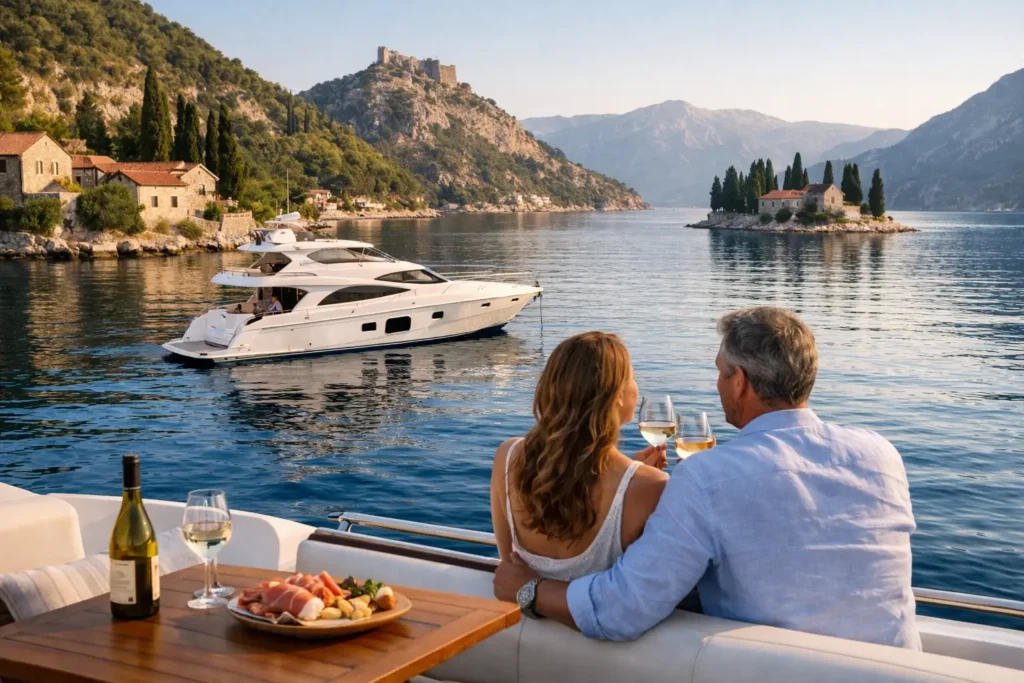
A yacht anchored below the stone homes of a family village is a very different experience from simply arriving at another beautiful port. Adriatic yachting offers extraordinary coastlines, clear water, and historic islands, but for travelers with Croatian or Slovenian roots, its real value is the freedom to place personal history at the center of the journey.
This is not a cruise built around a fixed schedule and a crowded shore excursion. It is an opportunity to move gracefully between the places that shaped your family story: a Dalmatian harbor where a grandparent departed, an island parish holding generations of records, a hill town where relatives still gather for Sunday lunch. The yacht provides privacy and comfort. The itinerary provides meaning.
Adriatic Yachting Is More Than a Route Between Islands
The Adriatic rewards travelers who can slow down. Its most memorable moments are rarely confined to a major landmark or a famous waterfront. They happen over coffee with a local historian, during a private tasting at a family-run konoba, or while looking across a harbor your ancestors may have known by another name.
Croatia’s coast is especially well suited to this style of travel. Hundreds of islands create a natural rhythm of short, scenic passages and intimate stops. One day may begin in Dubrovnik beneath its medieval walls and end in a quiet bay near Mljet. Another may pair the elegant streets of Hvar with an inland visit to a village connected to your surname. A yacht allows these contrasts to exist in the same day without making the experience feel rushed.
Slovenia adds another dimension for families whose stories extend beyond the coast. Its compact geography makes it possible to connect a private Adriatic voyage with Ljubljana’s graceful old town, the wine country of Goriška Brda, the Karst region, or ancestral communities near the Italian border. For many families, the most satisfying itinerary is not limited by modern national boundaries. It follows the geography of their heritage.
Why a Private Yacht Changes the Experience
A private yacht is not always the only right choice. Boutique ships can be a wonderful fit for travelers who enjoy a sociable atmosphere, prefer a more structured journey, or want to visit the highlights of the Dalmatian coast without planning every detail. They offer polished service and a sense of ease, particularly for couples or smaller groups who appreciate shared dining and a ready-made route.
Private yachting is different because it gives your story room to lead. Departure times can shift to accommodate a meaningful village visit. A morning can remain open for a genealogist, a museum curator, or a private guide. If a secluded cove becomes the setting for an afternoon swim with children and grandchildren, there is no need to leave because a group itinerary says otherwise.
That flexibility matters most when heritage is involved. Research can reveal a church archive worth visiting, a cousin who is available only on a certain day, or a small cemetery outside a town that larger vessels cannot easily serve. A tailored vessel and crew make it possible to treat these moments as the heart of the trip rather than an interruption to it.
The level of yacht should reflect how you want to travel. A sleek motor yacht suits guests who value speed, contemporary design, and access to more distant islands. A sailing yacht brings a quieter, more elemental connection to the sea. For multigenerational groups, a spacious gulet or luxury small vessel may offer the best balance of private cabins, generous gathering areas, and relaxed hospitality. The right choice depends on your group, your pace, and the kind of memories you hope to make together.
How Roots-Based Adriatic Yachting Takes Shape
The most compelling itineraries begin well before the first port. They begin with conversations about family names, hometowns, migration stories, old photographs, and the details you wish you knew. A relative may remember that their father came from an island called Brač, but not the village. A family document may list an Austro-Hungarian place name. Those fragments can become the starting point for meaningful research and thoughtful route planning.
At Adriatic Roots Cruises, each journey is designed from scratch around those details, pairing high-end cruising with local knowledge and optional genealogy support. The aim is not to turn every day into a research appointment. It is to create a beautiful, well-paced vacation in which heritage experiences feel natural, personal, and deeply considered.
A family tracing roots to Korčula, for example, might begin with a private arrival in Split and a night in a refined waterfront hotel. Once aboard, the yacht could travel south through the islands, with time for a guided walk through Hvar Town and an afternoon in the Pakleni Islands. On Korčula, the itinerary might shift inward: a visit to the ancestral village, a meeting with local relatives, lunch featuring regional wines and olive oil, and a quiet stop at the parish church where generations of a family were baptized.
For a couple with Slovenian heritage, the experience may be more land-and-sea in character. A private yacht along the Istrian and Dalmatian coast can be paired with time in Slovenia’s countryside, where a guide provides context that a map cannot. You might move from coastal Piran to the vineyards of Brda, then continue to Ljubljana or Lake Bled, carrying the same attentive service and cultural depth throughout the trip.
The Details That Make a Luxury Journey Feel Personal
Luxury is not only a larger suite or a chilled glass of sparkling wine on deck, though both have their place. For heritage travelers, true luxury is having the right person open the right door at the right time. It is arriving at a village knowing why it matters, rather than trying to interpret a faded address on your own.
That may mean reserving a private guide who understands the history of Dalmatian migration to the United States. It may mean arranging a meal with a local family, a behind-the-scenes visit to a UNESCO-listed site, or a chef-led dinner that introduces the regional dishes your grandparents once described. It can also mean protecting unstructured time. A meaningful journey needs room for swimming, reading on deck, and letting a sunset dinner last longer than expected.
Thoughtful planning also protects privacy. An ancestral visit can be emotional, especially when several generations travel together. Private transportation, discreet guides, and a vessel that belongs only to your party create space for those feelings without turning them into a performance for strangers.
Plan for the Pace You Actually Want
The temptation in the Adriatic is to see every celebrated island. Yet a journey shaped by personal connection is usually stronger when it does less, more deliberately. Four islands with time to explore can feel far richer than seven ports experienced from a checklist.
For first-time visitors focused on the southern coast, seven to ten nights allows for a satisfying route between Split and Dubrovnik, with meaningful time in places such as Brač, Hvar, Vis, Korčula, and Mljet. Families adding ancestral villages or inland Croatia often benefit from several land nights before or after the voyage. Travelers combining Croatia and Slovenia should allow enough time to transition between regions without making the itinerary feel like a relay race.
Season matters, too. May, June, September, and early October often offer a more relaxed atmosphere, pleasant temperatures, and stronger availability for private experiences. July and August bring brilliant weather and lively energy, but popular harbors and historic towns are busier. For a multigenerational celebration, the best month depends on whether your priority is school schedules, warm-water swimming, quieter villages, or a balance of all three.
The Adriatic is full of beautiful routes. The one worth taking is the one that lets your family recognize itself in the landscape. When the boat departs and the coast grows quiet behind you, the journey should leave you with more than photographs: a clearer sense of where your story began and the people with whom you chose to share it.