
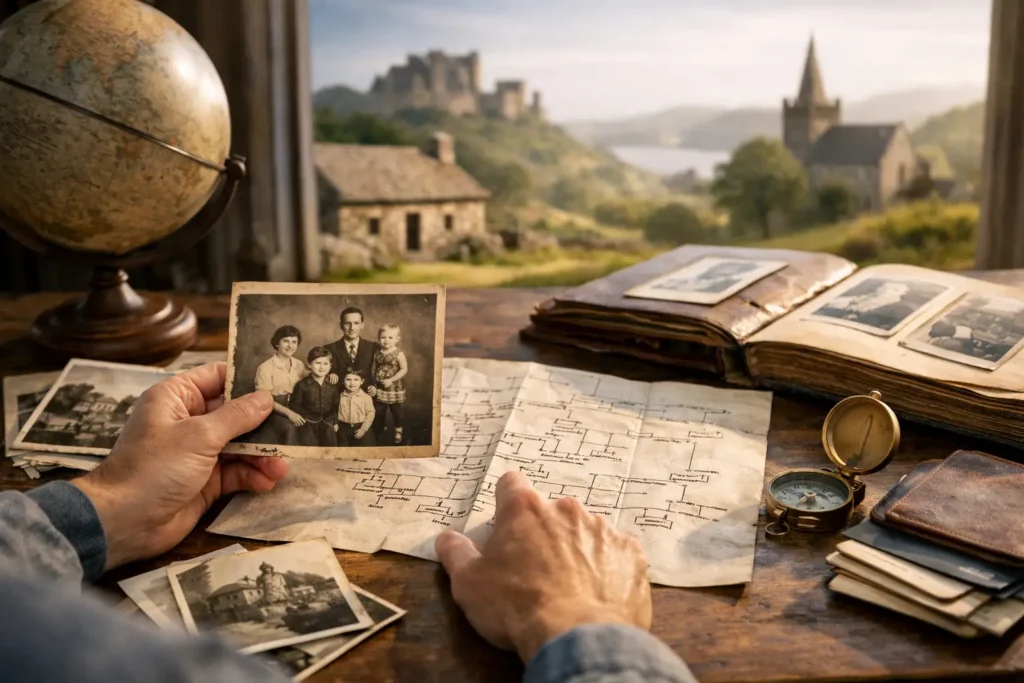
A church register can preserve a name for more than a century. A stone house in a hillside village can hold the memory of a family long after its descendants have settled in Chicago, Cleveland, or California. Standing in that place changes what travel can mean. Heritage tourism is not simply visiting beautiful destinations with a family connection. It is the rare opportunity to place your own story within the landscapes, traditions, and communities that shaped it.
For travelers with roots in Croatia, Slovenia, and the wider Dalmatian cultural sphere, the journey often begins with a question: Where did my family come from? The most memorable answer is rarely found in a single document or a rushed stop on a group itinerary. It unfolds gradually, through a village lane, a local meal, a conversation with a guide who understands the region, and time spent on the water between places that once felt impossibly far apart.
What Heritage Tourism Can Give You
Conventional sightseeing tells you what is famous. A heritage-centered journey helps reveal what is personal. Both have their place, of course. There is real pleasure in seeing Dubrovnik’s walls, Split’s ancient heart, Lake Bled, or the old towns of Istria. Yet for a family tracing a grandfather’s surname to an island village or a couple honoring a milestone with a deeper connection to the Adriatic, those celebrated places become more meaningful when they are part of a story designed around their own roots.
That distinction is especially powerful in the Adriatic. The region’s history is layered with shifting borders, languages, empires, migrations, faiths, and maritime traditions. A family may identify as Croatian while its records appear in Italian, German, Latin, or Slovenian. A surname may have changed spelling after immigration. The village named in an old passenger manifest may now belong to a different municipality than it did when an ancestor departed.
Heritage travel makes room for that complexity. Rather than treating uncertainty as an inconvenience, a thoughtful itinerary uses it as a starting point. It can pair archival research with local knowledge, private visits with unhurried exploration, and the comfort of exceptional hospitality with the emotional honesty of discovering that not every answer is simple.
Heritage Tourism Is Not a Standard Itinerary
A heritage journey should not feel like a standard cruise with one ancestral stop added to the schedule. Your family history deserves more care than that. The right experience begins well before departure, with a conversation about what you know, what you hope to find, and how you want the journey to feel.
Some travelers arrive with a detailed family tree, village names, baptismal records, and inherited photographs. Others have only a surname, a story told by a grandmother, or the knowledge that their family came from somewhere near the Dalmatian coast. Both are enough to begin. The research process may clarify an ancestral town, identify regional context, or uncover useful questions for local experts. It may also reveal that a planned visit needs to be adjusted. Flexibility is a strength, not a compromise, when the journey is rooted in real history.
The experience should also reflect your preferred pace. A multigenerational family may want a private yacht as a graceful home between island visits, with easy transfers, spacious time ashore, and activities that appeal across ages. A couple may prefer boutique hotels, private tastings, and quiet evenings in historic towns. Another traveler may want to combine a village visit with UNESCO sites, museum collections, and a meeting with a local historian. Luxury is not one fixed formula. It is the freedom to make the day feel entirely your own.
The value of privacy and time
An ancestral village is not a place to rush through between breakfast and a crowded coach departure. You may want time to walk to the parish church, pause at a cemetery, notice the landscape described in family stories, or simply sit with what it means to be there. A private driver and knowledgeable guide create the space for those moments without sacrificing comfort or precision.
On the coast, a privately chartered vessel adds another dimension. The sea has always connected Adriatic communities, and traveling by water offers a natural rhythm between heritage sites. You can wake near a historic island settlement, swim in a quiet bay after a morning of exploration, then arrive for dinner in a harbor where Venetian, Slavic, and Austro-Hungarian influences still appear in the architecture and table traditions.
How to Plan a Journey Around Your Roots
The strongest heritage itineraries balance preparation with openness. Begin by gathering the materials already within your family: immigration papers, letters, photographs, certificates, oral histories, name variations, and even recipes or religious traditions. Small details can be useful. A remembered patron saint, a reference to an island, or a surname associated with a particular parish may help narrow the search.
Next, decide what success would look like. For some, it is visiting a specific birthplace or locating a family grave. For others, it is understanding the region their ancestors left behind. Those goals are different, and a well-designed trip should honor either one. Genealogy can be deeply rewarding, but records may be incomplete, inaccessible, or written in unfamiliar scripts. The value of the journey should never depend solely on a dramatic archival discovery.
Then consider how much of the trip should be explicitly ancestral. A full heritage-focused program suits travelers with several places to visit and a strong research interest. Others prefer an itinerary where roots provide the emotional center, while the days also include sailing, art, wine, architecture, and exceptional dining. There is no need to choose between meaning and pleasure. The most enduring journeys usually hold both.
At Adriatic Roots Cruises, this process is built around consultation rather than a preset package. A tailored itinerary can bring together private Adriatic cruising, luxury accommodations, regional experts, village visits, and optional genealogy support in a way that respects your family story and your standards for travel.
A Journey May Move From Records to Real Places
Imagine arriving in Zagreb or Ljubljana, where a private guide introduces the historical context behind the names and places in your family records. From there, the route may lead inland to a small town connected to an ancestor, with time for a parish visit and lunch at a family-run restaurant. The next chapter could be coastal: a private transfer to Split, then a yacht or boutique vessel waiting to carry you through central Dalmatia.
Each island can add a different perspective. Hvar may bring elegance, vineyards, and layered Venetian history. Korčula offers stone lanes and maritime traditions. Brač reveals villages, white-stone landscapes, and a quieter pace. Depending on your roots, an itinerary might turn toward Šibenik, the Makarska Riviera, the Kvarner Gulf, Istria, or the Slovenian coast. The route is shaped by geography, but it should be guided by significance.
A local meal can become part of the record of the trip. Perhaps your family remembers a dish by a different name, or perhaps a host explains why a recipe varies from one island to the next. These encounters do not prove a lineage, nor should they be presented as substitutes for research. Their value is more human: they make cultural inheritance tangible.
What Makes a Heritage Journey Feel Authentic
Authenticity is often confused with roughness or inconvenience. It does not require sacrificing thoughtful service, beautiful surroundings, or a well-organized day. In fact, comfort can make a heritage experience more meaningful by giving you the energy and time to be present.
What matters is that the journey is respectful. Local guides should bring context rather than performance. Village visits should be arranged with care, especially when meeting residents or entering sacred sites. Historical narratives should acknowledge the region’s complexity instead of offering easy stereotypes. And personal discoveries should be allowed to remain personal. Not every meaningful moment needs to be turned into an itinerary highlight.
It also helps to leave room for surprise. You might recognize a family name on a memorial, hear a dialect that echoes a phrase from childhood, or find that the place you expected to feel most important is not the one that stays with you. Travel designed around your story should have enough structure to feel effortless and enough openness to let those moments happen.
Bring copies of family documents, write down questions before meeting local experts, and ask older relatives for stories before you leave. Then give yourself permission to arrive without a script for how you are supposed to feel. Your roots are not a museum exhibit. They are a living connection, waiting to be met with curiosity, care, and time.