A harbor can be more than a place to arrive. It can be the threshold to a family name, a dialect remembered by grandparents, a parish register, or a stone house still held in local memory. The best Adriatic ports for culture are not simply the ones with the most photographed old towns. They are the places where a private cruise can open into a more personal story – with enough time, local access, and thoughtful planning to let the destination speak for itself.
For travelers with Croatian, Slovenian, Italian, Austrian, or wider Dalmatian roots, the Adriatic offers an unusually layered cultural map. Roman trading cities sit beside Venetian walls; island communities preserve food traditions and songs distinct from the mainland; and small ports provide practical gateways to ancestral villages that larger cruise itineraries often miss. The right route depends on whether your story leads toward Istria, the islands of Dalmatia, the Bay of Kotor, or the Slovenian coast.
What Makes the Best Adriatic Ports for Culture?
A culturally rewarding port should offer more than a scenic promenade. It needs a strong sense of place, knowledgeable local guides, and meaningful experiences within reach of the water. In heritage-focused travel, it also helps if a port can serve as a comfortable base for private inland excursions, whether that means visiting a village, meeting a local historian, or arranging a lunch in the region your family once called home.
The trade-off is pace. Dubrovnik and Split are rich in landmark sites and easy to access, but they can be busy in peak season. Smaller ports such as Korcula, Sibenik, and Koper often feel more intimate, though their cultural riches reward travelers willing to look beyond headline attractions. A private yacht or boutique vessel makes that choice easier: you can arrive early, stay late, and shape each day around your interests rather than a fixed port schedule.
Dubrovnik: For Layers of History and Dramatic Arrival
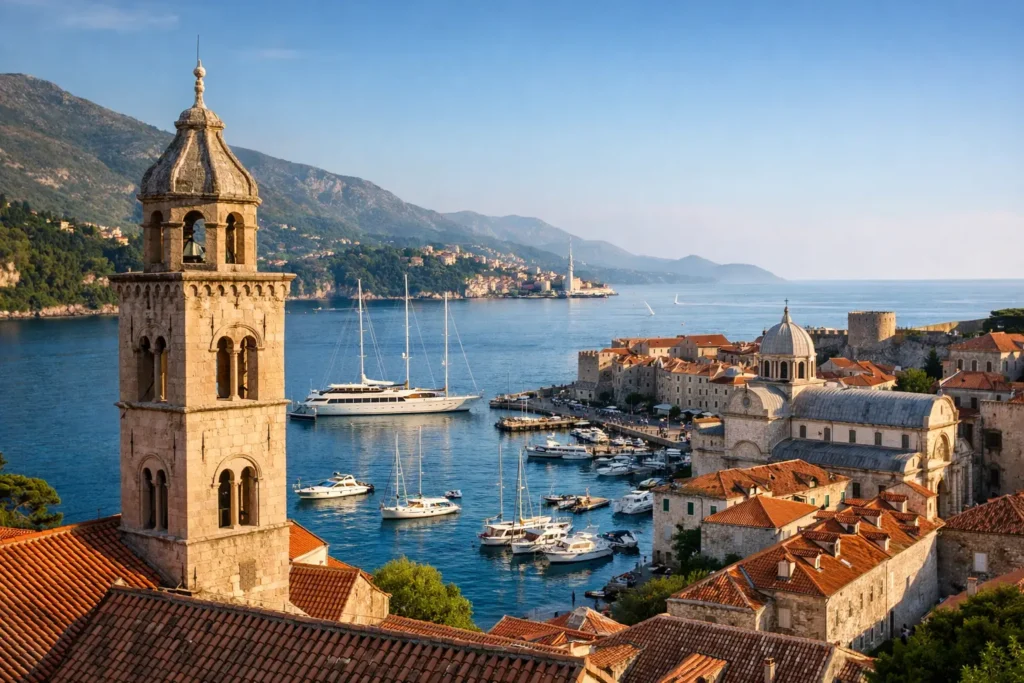
Dubrovnik is an essential cultural port for travelers drawn to the former Republic of Ragusa, one of the Mediterranean’s most sophisticated maritime powers. Its limestone streets, aristocratic palaces, monasteries, and defensive walls tell a story of diplomacy, trade, and fierce independence. The city’s beauty is undeniable, but its deeper appeal lies in the details: the archives, the Franciscan pharmacy, the quiet lanes behind the Stradun, and the traditions of the Konavle region just beyond the city.
For families with roots in southern Dalmatia, Dubrovnik can also be the beginning rather than the centerpiece. A private driver and local guide can turn a port day into a visit to ancestral communities in Konavle, the Peljesac Peninsula, or nearby islands. Plan an early-morning walk through the Old Town, then leave the crowds behind for a private tasting, countryside lunch, or family-history excursion.
Split: For Roman Legacy and Dalmatian Life
Split is one of the Adriatic’s most alive historic cities because its Roman heart is still a living neighborhood. Diocletian’s Palace is not an isolated monument. Residents pass through its gates on their way to work, cafés fill its courtyards, and generations of architectural change have been built directly into its ancient walls.
This makes Split particularly compelling for travelers who want history without museum glass between them and the present. It is also a strong departure point for central Dalmatian family roots, with access to the inland villages, coastal towns, and islands that supplied the city for centuries. A well-designed day may pair a private palace walk with a visit to Salona, the Roman capital of Dalmatia, followed by a long lunch featuring peka, local olive oil, and wines from the nearby hills.
Hvar Town: For Venetian Elegance and Island Tradition
Hvar Town has a glamorous reputation, yet its cultural identity runs far deeper than its waterfront scene. Venetian governance shaped its graceful square, arsenal, and fortifications, while the island’s interior preserves a quieter heritage of lavender farming, stonework, fishing, and wine production.
The port suits travelers who want both polish and authenticity. Spend time in Hvar Town with a guide who can explain its maritime past, then continue by private vehicle to villages such as Vrboska, Jelsa, or Stari Grad. The Stari Grad Plain, cultivated since Greek antiquity, reveals a different Hvar: one of dry-stone walls, small family plots, and agricultural traditions maintained across centuries.
Korcula: For Stories of Seafaring Families
Korcula Town rises from the water like a compact medieval citadel, its narrow streets arranged to shelter residents from wind and sun. Often associated with Venetian influence and seafaring tradition, it is one of the most atmospheric places to understand island life in southern Dalmatia.
For heritage travelers, Korcula is especially valuable because its cultural story extends far beyond the walled town. Nearby villages maintain distinctive customs, including the island’s historic sword dances, while family-run konobas offer meals rooted in local fishing and farming traditions. It is an ideal port for an unhurried evening ashore, when day visitors have departed and the stone lanes return to their natural rhythm.
Sibenik: For a More Intimate Dalmatian Story
Sibenik often surprises travelers who know Croatia only through Dubrovnik and Split. It has a handsome medieval center, a dramatic waterfront, and the Cathedral of St. James, a UNESCO-recognized masterpiece built entirely of stone. Its sculpted faces are particularly moving – ordinary citizens from centuries ago still looking out over the city.
Culturally, Sibenik offers a more intimate experience of coastal Dalmatia. It is a useful gateway to the Krka region, where river settlements, monasteries, and rural traditions offer a counterpoint to the coast. For guests tracing family roots in the Sibenik hinterland, this port can create the rare opportunity to combine a refined day on the water with a meaningful visit inland.
Zadar: For Roman Ruins, Resilience, and Regional Flavor
Zadar’s old town rests on a peninsula where Roman streets, Romanesque churches, Venetian gates, and Austro-Hungarian traces sit close together. It has endured repeated destruction and reinvention, giving the city a character that feels less staged than some better-known ports. The Church of St. Donatus, the Roman Forum, and the local market offer three very different ways into its story.
Zadar is also a fine choice for travelers whose interests lie in northern Dalmatia, the Ravni Kotari countryside, or islands such as Ugljan and Pasman. A private itinerary can combine historical sites with a visit to an olive grower, cheesemaker, or village market. Those encounters often bring the region’s heritage into sharper focus than a formal tour alone.
Rovinj: For Istrian Italianate Culture
Rovinj feels distinct from Dalmatia, and that distinction is precisely its appeal. The old town climbs a peninsula beneath the Church of St. Euphemia, with Italian spoken alongside Croatian and Venetian influence visible in its facades, fishing boats, and food culture. This is a port for travelers drawn to the borderland character of Istria.
From Rovinj, private excursions can reach Pula’s Roman amphitheater, the hill towns of central Istria, and family farms producing truffles, olive oil, and Malvasia wine. It is particularly rewarding for guests whose family stories move between Italian and Croatian identities, or whose roots are tied to the former Austro-Hungarian world.
Koper: For Slovenian Heritage and a Crossroads Perspective
Slovenia’s short coastline carries an outsized cultural weight, and Koper is its historic heart. Once a Venetian city, it has elegant squares, a cathedral, and a character shaped by Slavic, Italian, and Central European influences. It provides a graceful entry point for travelers who want to include Slovenia without treating it as an afterthought.
Koper can lead naturally to the salt pans of Secovlje, the coastal town of Piran, or inland villages in the Karst region. For those exploring Slovenian family roots, it can also be paired with more extensive land travel toward Ljubljana, the Vipava Valley, or the regions where a family’s story began.
Designing a Cultural Route Around Your Story
The most memorable Adriatic itinerary rarely tries to collect every famous port. A couple celebrating an anniversary may prefer Dubrovnik, Korcula, Hvar, and Split, with time for private dinners and village visits. A multigenerational family with Istrian or Slovenian roots may find greater meaning in a route centered on Rovinj, Koper, and carefully chosen inland stays.
At Adriatic Roots Cruises, cultural planning begins with the questions that standard cruise brochures do not ask: Where did your family come from? Which traditions still matter to you? Do you want to see landmarks, or do you want to sit at a local table and hear how a place remembers itself? From there, a route can be shaped around privacy, comfort, and the kinds of encounters that cannot be scheduled on a large-ship timetable.
Choose ports with room for discovery, not just a list of attractions. When the yacht departs at sunset, the lasting memory may not be the skyline at all. It may be the church bell from an ancestral village, a surname spoken with recognition, or the feeling that a distant place has become part of your story again.