
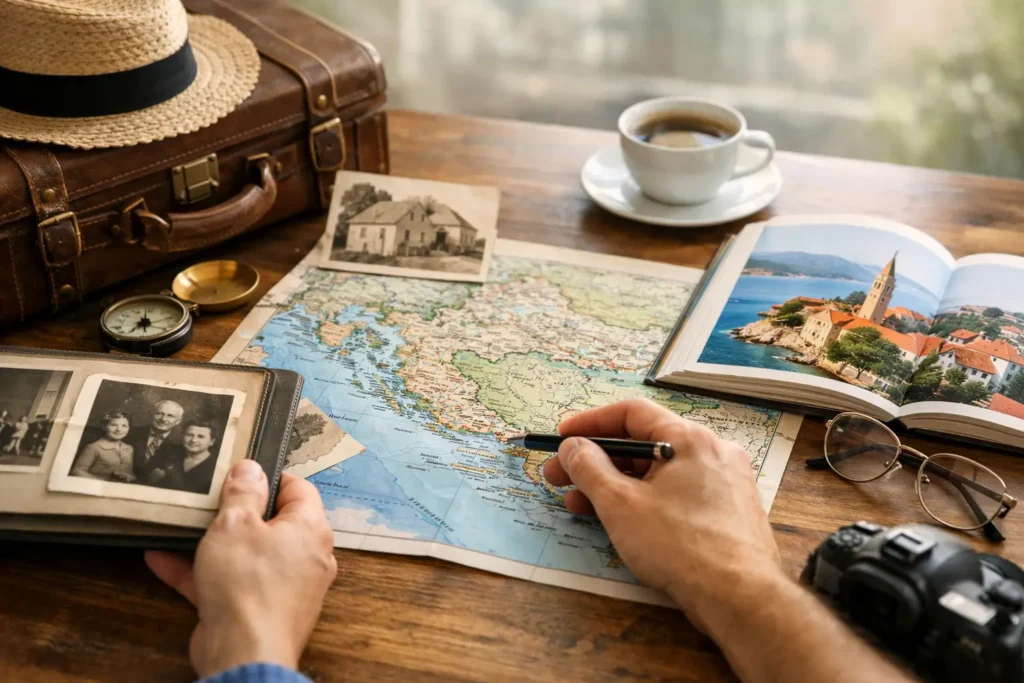
A faded surname on a passenger manifest can become the beginning of a remarkable journey. Croatian ancestry travel planning is not simply about locating a village on a map. It is about standing where your family once stood, hearing the cadence of a local dialect, sharing a meal shaped by the same landscape, and giving the next generation a living connection to its story.
For families with roots in Dalmatia, Istria, the islands, Zagreb, Slavonia, or the former Austro-Hungarian and Venetian territories of the Adriatic, the most meaningful trips balance discovery with ease. A carefully designed journey leaves room for the unexpected: a parish record, an elderly neighbor who recognizes a family name, or a quiet moment at a harbor your ancestors may have known.
Begin Croatian Ancestry Travel Planning With the Story You Have
You do not need a complete family tree before you travel. A surname, an approximate town, a family saint’s day, an old photograph, or a relative’s memory can all offer useful direction. Still, the more you can gather before departure, the more personal your time in Croatia can become.
Start with the details held closest to home. Ask relatives for birth certificates, marriage records, letters, military papers, obituaries, and the names of parents or siblings. Note alternate spellings. Croatian names were often adapted after immigration, while place names may appear in Croatian, Italian, German, Hungarian, or older regional forms. A family who said they came from “Austria” or “Yugoslavia,” for example, may have roots in a village that is now within Croatia.
It also helps to distinguish between what is known and what is family lore. Both matter. Documented facts can guide archival research, while stories often shape the emotional heart of an itinerary. Perhaps your grandmother spoke of olive harvests on an island, a stone house above Split, or a long voyage from Rijeka. Those fragments can point toward experiences that make a journey feel unmistakably yours.
Let research shape the route, not consume the trip
Genealogy can be wonderfully absorbing, but travel should not become a week spent in reading rooms. Some records are held locally, some are restricted, and some villages have seen boundaries and parish jurisdictions change over generations. Results can take time.
The most satisfying approach is to use research to create a strong foundation, then build a generous travel experience around it. If records identify an ancestral village, arrange time there with a knowledgeable local guide. If the exact origin remains uncertain, focus on the wider region connected to your family and the culture that formed their lives. Meaning does not depend on proving every branch of a family tree.
Choose the Right Pace for Your Roots Journey
Croatia is compact on a map but richly varied in practice. A route that looks simple can involve mountain roads, ferry schedules, island transfers, and historic centers best experienced on foot. For travelers who value privacy and comfort, the question is not how much can fit into one itinerary. It is how each place can be experienced without rushing past its significance.
A private yacht or boutique ship is especially compelling when your story follows the coast or islands. It allows you to move between destinations while your accommodations, service, and dining travel with you. After a morning in an ancestral village, you might return to a quiet cove near Hvar, a sunset aperitif off Korčula, or dinner prepared with ingredients from the region.
Land time remains essential when family history leads inland. Zagreb can provide access to archives and cultural institutions. Istria offers a layered Croatian-Italian heritage and hill towns shaped by centuries of trade. The Dalmatian hinterland reveals a different rhythm from the coast, with vineyards, small churches, and communities where surnames can carry deep local memory. A considered land-and-sea itinerary gives each setting its proper place.
A sample rhythm for a multigenerational family
A family with Dalmatian roots might begin with two nights in Split, allowing time to settle in and explore the city’s Roman and Venetian layers. The next day could include a private visit to the ancestral village, a stop at the parish church or cemetery, and lunch at a family-run konoba where regional dishes tell their own story.
From there, a private cruise can continue through Brač, Hvar, Vis, Korčula, and Dubrovnik, with the route adjusted to the family’s interests and sea conditions. One generation may want a guided walk through UNESCO-listed cities; another may prefer swimming, wine tasting, or an afternoon with no agenda at all. The beauty of a custom itinerary is that neither preference has to diminish the other.
Make Ancestral Visits Feel Respectful and Real
An ancestral village is not a museum set aside for visitors. It is someone’s home, often a small community where privacy and local relationships matter. The most meaningful visits are prepared thoughtfully, with context, care, and enough time to let the encounter unfold naturally.
A local guide can explain customs, help interpret names and inscriptions, and introduce the village beyond the single address you may be seeking. A churchyard may reveal relatives, but it can also reveal the history of the community – which families remained, which departed, and how faith, work, and migration shaped daily life. In coastal regions, a simple stone facade or family grave can hold centuries of movement across the Adriatic.
When a family home is still occupied, it is best not to arrive unannounced. In some cases, a respectful introduction can be arranged. In others, viewing the property from the exterior and learning its history is more appropriate. The goal is connection, not access at any cost.
Bring copies of photographs or documents if you have them. They can prompt recognition and conversation, particularly with older residents. But leave room for a visit to be quiet, too. Not every ancestral place offers a dramatic revelation. Sometimes the deepest response is simply seeing the terrain: the road your family walked, the hills above the village, the stretch of sea that may have represented both departure and possibility.
Add the Experiences That Give History Texture
Family history becomes more vivid when it is paired with the sensory life of a region. A surname may lead you to a town, but food, music, craftsmanship, and landscape help you understand what it meant to come from there.
In Dalmatia, that might mean tasting olive oil near the grove-lined slopes of Brač, joining a private wine tasting on Pelješac, or learning how peka is prepared beneath its iron bell. In Istria, it may be a truffle-focused lunch, a visit with a winemaker, and time in a hill town where Croatian and Italian influences meet. Around the Bay of Kotor in neighboring Montenegro, Venetian-era architecture and dramatic coastal scenery offer a natural extension for families whose stories crossed former maritime borders.
These experiences should not feel like decorative additions. They create conversation across generations. A grandchild who cannot read a parish register may remember helping prepare a regional dish or listening to a guide explain why a particular harbor mattered to emigrants. Heritage travel works best when every traveler has a way into the story.
Plan for Privacy, Flexibility, and Emotion
Roots journeys can bring unexpected feelings to the surface. A traveler may be moved by a name carved into stone, disappointed by an inconclusive search, or overwhelmed by the responsibility of sharing family history with children. A well-paced private itinerary makes room for all of it.
Avoid tightly scheduled days after an ancestral visit. Leave time for a long lunch, a swim, a spa treatment, or an unhurried evening onboard. Luxury, in this context, is not only beautiful surroundings. It is the freedom to pause when a place means more than expected.
Flexibility also matters logistically. Weather can alter a cruising route, archives may have limited hours, and a local contact may only be available at a particular time. Working with specialists who understand both Adriatic travel and heritage-focused planning helps turn those variables into thoughtful adjustments rather than disruptions. At Adriatic Roots Cruises, each route is shaped around the family story as much as the map.
Travel With Something to Pass On
Before leaving Croatia, consider how you will preserve what the journey revealed. Keep a simple journal, record a few conversations with relatives, save copies of documents, and label photographs while names and places are fresh. If you are traveling as a family, invite each person to choose one memory they want to carry forward.
The value of an ancestry journey is rarely measured by how many records are found or islands visited. It lives in the moment a familiar surname is spoken with local pronunciation, in a shared table overlooking the Adriatic, and in the knowledge that your family story now has a landscape, a voice, and a future.