
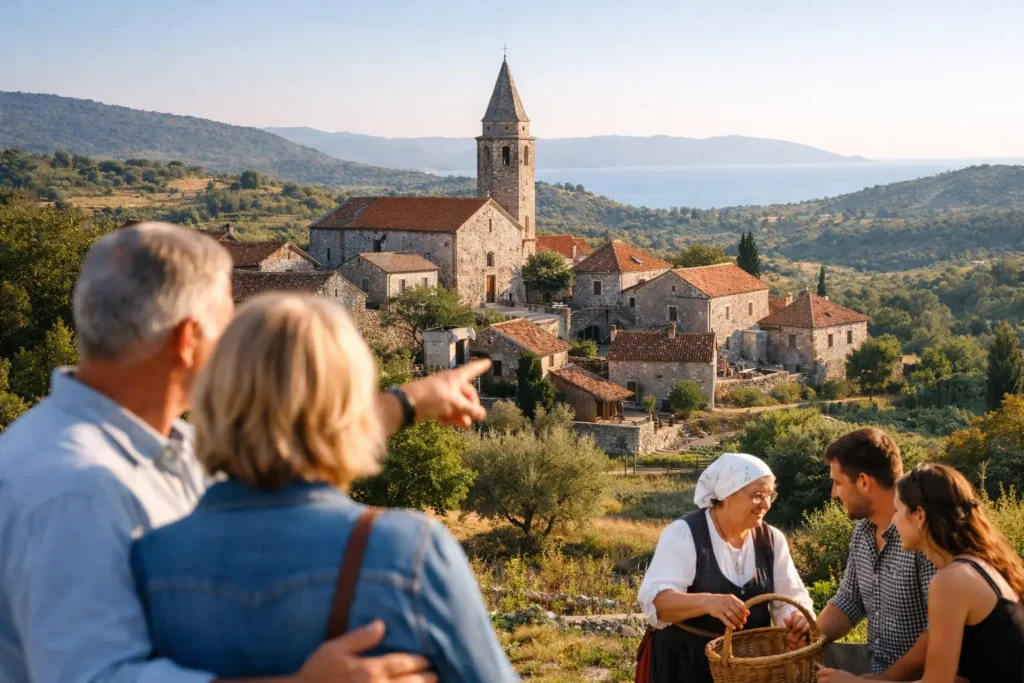
A family name on an old passenger list can feel abstract until you stand beneath the bell tower your great-grandparents knew, hear the local dialect, and see the stone paths that led from their home to the fields. That is the promise of ancestral village tours Croatia: not simply visiting a place on a map, but giving your family story a setting, a texture, and a sense of scale.
For travelers with Croatian roots, the most meaningful journey is rarely built around a checklist of famous sights. It is shaped around the village name remembered in a grandmother’s kitchen, the island marked on a baptismal record, or the coastal town where a family departed for America. With thoughtful preparation and private local guidance, a heritage visit can be both deeply personal and beautifully paced.
Why a Village Visit Changes the Journey
Croatia’s most famous places are deservedly compelling, from Dubrovnik’s walls to Split’s Roman heart and the islands scattered along the Dalmatian coast. Yet an ancestral village offers a different kind of encounter. It may be a hillside settlement of pale limestone homes, a quiet inland parish, or a harbor where fishing boats still come in at dusk. The details are often modest. Their meaning is not.
A visit can place family migration in context. You may understand why relatives left a rocky island with limited farmland, why a border region produced several languages within one family, or why an Italian or Austrian influence appears in names, recipes, and church records. The experience can be moving, but it is not staged sentiment. It is the chance to see the real geography that shaped a family’s decisions.
For multigenerational travelers, this creates a rare shared experience. Older relatives can offer memories and questions; younger family members can connect names in a genealogy chart to landscapes they can walk through together. A private meal in the region, a conversation with a local historian, or a pause at a parish cemetery may become the moment everyone remembers most.
What Makes Ancestral Village Tours in Croatia Meaningful
The best heritage travel respects both the emotional weight of the journey and the practical realities of the region. Many villages are small, records can be incomplete, and family homes may be privately owned. A meaningful itinerary does not promise a dramatic revelation at every stop. Instead, it is designed to create authentic access where possible and thoughtful context everywhere else.
Research begins with what your family already knows
A successful trip often starts with a small collection of clues: surnames, dates of birth, a place spelling from a ship manifest, old photographs, religious affiliation, or even a vague recollection that a family came from “near Split” or “an island off the coast.” These details help distinguish between villages with similar names and account for historical changes in spelling, borders, and administrative districts.
It also helps to be flexible about certainty. A record may identify a parish rather than a village, or use an older place name from the Austro-Hungarian period. In some cases, the strongest connection is regional rather than tied to one exact doorstep. That does not diminish the journey. It simply changes the story your itinerary is built to tell.
Local knowledge brings the place into focus
A knowledgeable private guide can explain details that are easy to miss when traveling independently: the role of a village church, the history of emigration from a particular island, the significance of a family nickname, or the local traditions associated with a saint’s day. Where appropriate, advance coordination may allow time with a parish representative, municipal contact, regional archive, or local historian.
These encounters should feel respectful, never intrusive. Village communities are living places, not open-air museums. The most rewarding visits leave room for genuine conversation while honoring privacy, local schedules, and the fact that a present-day home belongs to someone else’s family story, too.
Comfort creates space for reflection
Heritage travel can involve narrow roads, ferry schedules, rural distances, and unpredictable opening hours. Private transportation, a flexible pace, and carefully selected accommodations make a substantial difference. Rather than racing back to a crowded ship departure, you can take time for coffee in the town square, linger over a regional lunch, or adjust the day when a meaningful opportunity appears.
This is where luxury has real purpose. It is not only about beautiful cabins, exceptional dining, or a chilled glass of local wine after an excursion. It is about having the ease and privacy to be present for an experience that may be unexpectedly emotional.
Pairing Your Roots With the Adriatic
A land-and-sea itinerary is particularly well suited to Croatian heritage travel because so many family stories are connected to the coast. From a private yacht or boutique vessel, you can move gracefully between island communities and historic ports while keeping your journey centered on the places that matter most to you.
Imagine beginning in Split, where a private guide introduces the layers of Roman, Venetian, and Croatian history that influenced Dalmatian life. From there, you might sail toward Brač, Hvar, Korčula, or Vis, depending on your family’s origins. A day ashore can be reserved for the ancestral village, with time afterward to return to the water, dine aboard, and watch the coastline fade into evening.
For families whose roots lead inland, the itinerary can balance a village visit with Zagreb, Istria, the Plitvice region, or a private overland journey through the countryside. Those with a wider Adriatic story may continue to Slovenia or Montenegro, particularly when migration, marriage, trade, or old imperial borders connect the family across present-day countries.
There is no single ideal route. An island-born family may want several unhurried days among the Dalmatian islands. Another traveler may prefer one profoundly researched village day within a broader itinerary of UNESCO sites, culinary experiences, and coastal sailing. The right design depends on how central the heritage visit is to your trip and how much time you want to devote to the surrounding region.
A Thoughtful Way to Plan Your Visit
Begin early, particularly if your trip is planned around summer sailing dates or if research may require outreach to local contacts. Share every detail you have, including documents that seem minor. A handwritten address, an old family photograph with a church in the background, or a passenger manifest can offer useful direction.
Be clear about what you hope to feel or accomplish. Some travelers want to stand in the village and absorb its atmosphere. Others hope to locate a parish record, visit a cemetery, or meet a distant relative if an introduction can be arranged naturally. These are different goals, and they call for different preparation.
It is also wise to leave room for surprise. The address may no longer exist. A church may be closed that day. A local conversation may reveal that a surname is common in a neighboring settlement rather than the village first identified. These moments are not failures of planning. They are part of working with real history, which is often layered, partial, and more interesting than a simple answer.
At Adriatic Roots Cruises, each journey is shaped around the level of privacy, research, and cultural immersion you want, combining tailored heritage experiences with the pleasure of refined Adriatic travel. The result is not a standard cruise with an ancestral stop added on. It is a journey where your roots help determine the route.
The Details Worth Making Time For
Some of the most lasting memories happen beyond the obvious landmarks. It may be a family-style lunch featuring the regional dishes your relatives once knew, a drive through vineyards and olive groves that explain the local economy, or a quiet stop at a cemetery where surnames repeat across generations.
Photography can be meaningful, but so can simply sitting still for a moment. Ask a guide about the rhythm of village life, the traditional work of the region, and how emigration changed the community. If you are traveling with children or grandchildren, invite them to carry a few questions of their own. Curiosity is often the most enduring souvenir.
Before you leave, consider what you would like to bring home beyond photographs. A written reflection, recorded family conversation, or a shared dinner where everyone tells one story from the day can preserve the experience in a way a souvenir never will.
Your ancestral village does not need to provide a perfect answer to every family question. It only needs to offer a place where the past becomes more tangible, and where the next generation can see that their story began somewhere real.