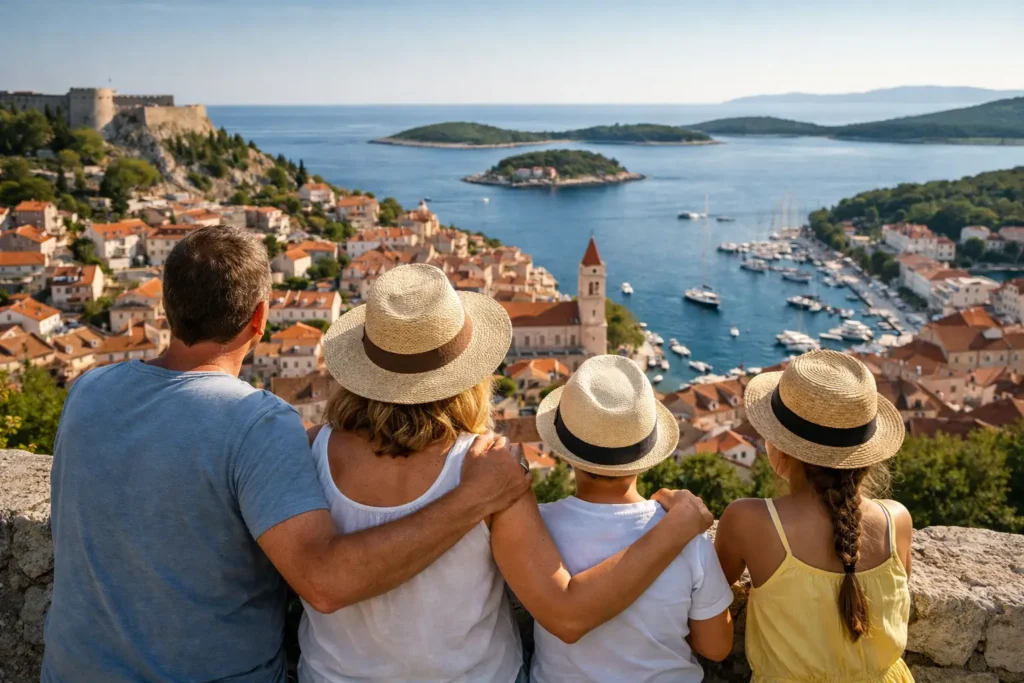
The moment a family name appears in an old parish register, a faded photograph, or a grandparent’s story about a stone village above the sea, a vacation starts to feel like something more. A Dalmatian coast family heritage trip is not simply about seeing Croatia’s prettiest ports. It is about standing in the places that shaped your people, while traveling with the comfort, privacy, and care that allow those moments to truly land.
For many American families, Dalmatia carries both clarity and mystery. You may know the island your great-grandfather left, the surname that changed at Ellis Island, or the saint’s day your family still honors. But turning those fragments into a meaningful journey is far more complex than booking hotels in Split and Dubrovnik. Heritage travel asks for nuance. It needs local knowledge, time to follow family threads, and an itinerary flexible enough to balance emotion, history, and pleasure.
That is why this kind of trip works best when it is designed around your story rather than around a standard route.
What makes a Dalmatian coast family heritage trip different
A conventional Adriatic itinerary might give you beautiful harbors, a few guided tours, and dinner reservations with a view. Those elements still matter, especially when you want the trip to feel polished and restorative. But family heritage travel adds another layer entirely.
You are not only moving through destinations. You are tracing relationships between coastal cities, island communities, church records, migration routes, and family memory. One branch of your family may have come from a village in the hills above Makarska, while another had ties to Korcula or Brac. A surname may point toward a region, but local pronunciation, old borders, and record-keeping habits can complicate the picture.
That is where curation becomes essential. The best journeys combine elegant travel with well-paced research and interpretation. A private guide can provide historical context in Split’s old town, while a local fixer or genealogical contact may help confirm whether the family story about a chapel, a cemetery, or a stone house is likely to be true. When that work is done thoughtfully, the trip feels less like tourism and more like recognition.
Start with family history, then build the route
The most successful heritage itineraries do not begin with a map. They begin with what your family already knows.
Sometimes that means starting with documents: baptismal records, ship manifests, marriage certificates, naturalization papers, military service files, or handwritten notes tucked into a drawer. Sometimes it starts with oral history. A grandmother remembers olives, church bells, and a ferry crossing. An uncle remembers that the family came from near Omis, even if he cannot recall the village name. Those details may feel small, but they often shape the most meaningful days of the trip.
From there, the route can take form. If your roots connect to central Dalmatia, Split may be the natural anchor, with time added in nearby islands or inland villages. If your family story leans south, Dubrovnik and the Peljesac Peninsula may open more relevant paths. Some families need a blend of sea and land, especially when ancestral homes sit above the coast rather than directly on it.
This is where a bespoke approach matters. A yacht or boutique cruise experience gives you access to the beauty of the Dalmatian coast without requiring you to repack constantly, while private transfers and tailored excursions make it possible to leave the shoreline when your story calls you inland.
Why private cruising works so well for heritage travel
Luxury matters differently on a heritage journey. It is not only about aesthetics, though the Adriatic certainly rewards good taste. It is about having the time, calm, and flexibility to respond to emotional moments without friction.
A private cruise or custom land-and-sea itinerary allows for exactly that. If a village visit runs longer because a local resident recognizes your family name, your day can breathe. If a cemetery stop becomes unexpectedly moving, you do not need to rush back to a crowded coach. If three generations are traveling together, everyone can experience the journey at the right pace.
There is also a practical advantage. The Dalmatian coast is ideal for combining heritage exploration with refined leisure. You can spend the morning with a historian or local guide, then return to a beautifully prepared lunch on board. One day may be centered on archival research and family sites; the next may be devoted to swimming in a quiet bay or enjoying a private wine tasting on Hvar. The balance matters. Heritage travel can be deeply emotional, and comfort gives those emotions room.
A luxury trip can still feel deeply personal
Some travelers worry that a high-end experience might distance them from the authenticity they are seeking. In practice, the opposite is usually true.
When logistics are handled well, you are more present. You notice the bell tower in the village square, the cadence of local speech, the stonework on a family home, the generosity of someone who opens an old church for your visit. You are not distracted by ferry schedules, parking, language barriers, or the stress of trying to coordinate multiple regions on your own.
Luxury, at its best, creates intimacy. It allows your family to focus on connection rather than management.
Designing a Dalmatian coast family heritage trip for multiple generations
Multigenerational travel often turns a roots journey into something lasting. Parents may bring adult children so family stories are passed forward. Grandparents may want to return to a place they left decades ago. Teenagers may arrive curious but unsure, then become unexpectedly captivated when they see a surname carved into stone or hear how their family’s life once revolved around the sea.
That said, multigenerational planning requires tact. Not everyone wants the same level of historical depth. One person may want archives and churches. Another may care more about food, landscape, and private cultural experiences. A well-designed itinerary respects both.
That usually means alternating emotionally charged heritage days with lighter experiences that still feel rooted in place. A morning in an ancestral village might be followed by a relaxed afternoon cruising the Pakleni Islands. A visit to a family parish can pair beautifully with a dinner at a thoughtfully chosen konoba where regional dishes reflect the same local traditions your ancestors knew. The trip stays cohesive, but no one feels overprogrammed.
What meaningful heritage moments often look like
Not every roots-based experience arrives with dramatic certainty. Sometimes the most powerful moments are quiet.
It may be standing in a church where generations of your family were baptized, even if the original records are incomplete. It may be walking a hillside path and realizing the distance your relatives once covered on foot to reach the market town below. It may be hearing your surname pronounced the old way by a local guide. For some families, the turning point is meeting a resident who remembers an aunt, a house, or a story passed through the village.
There are also moments of ambiguity. Records may be missing. Borders may have shifted. Family legends may be partly right and partly embellished. That does not diminish the journey. In many cases, the real gift is not perfect proof but a richer understanding of where your family came from and how those places still live in you.
The value of expert local guidance
Independent travel in Croatia can be lovely, but heritage planning on the Dalmatian coast often benefits from trusted local coordination. The region’s beauty is obvious. Its deeper family and cultural layers are not always easy to access without relationships on the ground.
Local guides, drivers, historians, and genealogy specialists can help interpret surnames, regional customs, migration patterns, and village histories in ways that generic tours simply cannot. They also understand the rhythm of the area – when to visit a village for quiet reflection, how to arrange private access where possible, and which cultural experiences feel sincere rather than staged.
For travelers who want both emotional depth and exacting service, this is where a specialist such as Adriatic Roots Cruises can make the experience feel fully realized. The point is not to force your story into a prebuilt package. It is to shape every detail around your roots, your pace, and the standard of travel you expect.
Leave room for pleasure, not just meaning
A family heritage trip should be moving, but it should also be joyful. Your ancestors may have left Dalmatia under difficult circumstances. Returning does not have to feel heavy at every turn.
Part of honoring your family story is allowing yourself to enjoy the coast they knew differently – to linger over fresh seafood, swim below old stone towns, toast with local wine, and watch younger generations fall in love with the region in their own way. That pleasure is not separate from heritage. It is part of it.
The Dalmatian coast has a rare ability to hold both beauty and memory at once. If your journey is planned with care, you do not have to choose between emotional resonance and exceptional travel. You can have a trip that feels graceful on the surface and deeply personal underneath.
If you have been carrying fragments of a family story for years, this may be the right time to give them a setting, a landscape, and a return.