A stone lane in a Dalmatian village can tell you more than a museum label ever could. The family name etched into a cemetery wall, the church register held in a parish archive, the taste of a recipe your grandmother once made from memory – these are the details that turn a beautiful trip into something deeply personal. That is the promise of luxury heritage travel Croatia: not simply seeing the country, but returning to it in a way that feels elegant, intimate, and unmistakably your own.
For travelers with Croatian roots, standard itineraries often miss the point. They deliver the postcard version – Dubrovnik at sunset, Hvar from the water, a few hours in Split – but leave little room for the quieter places where family stories actually began. On the other hand, planning a roots journey independently can be complicated. Village records are not always easy to access, local logistics can be slow, and the most meaningful experiences rarely appear in mass-market travel guides.
That is where a bespoke approach matters. When heritage travel is paired with private cruising, exceptional accommodations, and careful local planning, the experience becomes both emotionally rich and beautifully effortless.
What luxury heritage travel in Croatia really means
At its best, luxury heritage travel in Croatia is not a genealogy project disguised as a vacation, nor is it a lavish trip with a token nod to family history. It is a thoughtful blend of both. The comfort matters – private transfers, refined accommodations, a yacht or boutique vessel that lets you move through the Adriatic with ease – but comfort is there to support the deeper purpose of the journey.
A well-designed heritage itinerary begins with your story. Perhaps your grandparents left an island near Korcula. Perhaps your family came from the inland villages above Makarska, or from a once Venetian town where Croatian, Italian, and regional identities overlap. In some cases, the connection is clear and documented. In others, it is more intuitive – a surname, an old photograph, a fragment of oral history. Either way, the trip should be shaped around what you know, what you hope to learn, and how you want to experience it.
Some travelers want time in archives and parish offices. Others want a softer heritage lens: private guided walks through old town centers, regional food traditions, meetings with local historians, or a visit to a village that holds emotional significance even if no formal records survive. Luxury, in this context, means having the freedom to choose the depth and pace that feel right.
Why Croatia is uniquely suited to this kind of journey
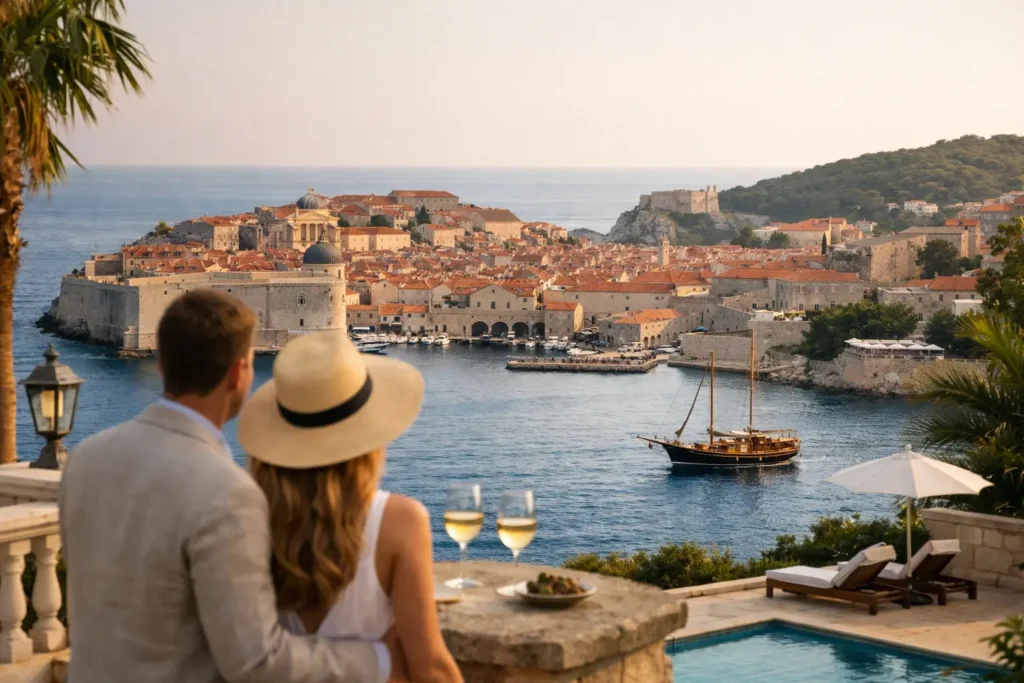
Croatia offers a rare combination of emotional resonance and natural grace. It is a place where ancestral discovery can happen alongside extraordinary coastal travel. You can spend the morning in a quiet inland hamlet tracing family origins and the afternoon sailing past limestone cliffs toward a candlelit dinner on deck.
The geography helps. The Adriatic coast is dotted with islands, historic ports, and former maritime communities whose identities were shaped by trade, migration, and empire. Inland, even short drives can lead to villages where surnames repeat across generations and local churches remain central to communal memory. This creates a powerful contrast – one day polished and cosmopolitan, the next rooted and deeply local.
Croatia also rewards travelers who value culture beyond surface-level sightseeing. Roman ruins, Venetian architecture, Austro-Hungarian influences, and Slavic traditions all coexist here. For many American families, especially those with ancestry tied to Dalmatia or the broader Adriatic world, that layered history mirrors their own. A heritage journey becomes not only a search for names and places, but a way to better understand how family identity was formed.
Luxury heritage travel Croatia works best when it is tailored
The greatest mistake in heritage travel is forcing a fixed itinerary onto a deeply personal story. One family may want a multigenerational journey with gentle pacing, private guides, and time for shared meals in meaningful settings. Another may prefer a more investigative trip, with pre-arranged archival research, village visits, and one or two strategic days at sea for rest and perspective.
Customization matters because emotions can shift during the journey. A village visit may become the high point of the trip, prompting more time nearby. A planned records search may reveal less than expected, making cultural immersion the more rewarding path. The best itineraries allow for both structure and flexibility.
This is also where land-and-sea travel is especially effective. Private cruising gives you privacy, calm transitions, and access to Croatia’s most beautiful coastal settings without the stress of constant packing or crowded ports. Land arrangements then bring you closer to your roots – whether that means a chauffeured visit to an ancestral town, lunch in a family-run konoba, or a guided day through a region your relatives once called home.
What a thoughtfully designed journey can include
A meaningful heritage trip is often built from several layers rather than one headline moment. There may be pre-trip family history research to clarify locations, surnames, migration routes, or parish affiliations. Once in Croatia, that groundwork can lead to experiences that feel both refined and emotionally direct.
You might begin in Split, settling into a discreet luxury hotel before boarding a private yacht. From there, the itinerary could move through Brac, Hvar, Korcula, or Vis, balancing time on the water with curated cultural encounters ashore. If your heritage points inland, a dedicated excursion might take you into the Dalmatian hinterland, where a local guide helps bridge language, context, and community connections.
For some travelers, the most memorable moments are surprisingly simple. Sitting with a village elder who recognizes a family name. Walking through an old cemetery and seeing generations arranged in stone. Visiting a church where baptisms, marriages, and farewells shaped your family long before anyone dreamed of crossing the Atlantic. Luxury does not diminish these moments. It protects them. It gives them space.
Cuisine can also play a powerful role. Heritage is often tasted as much as it is documented. A private meal inspired by regional family traditions, a market visit focused on ingredients tied to your ancestral region, or a wine tasting that opens a conversation about local continuity and change can deepen the experience in ways that formal research alone cannot.
The trade-off between discovery and certainty
It is worth saying plainly: heritage travel does not always provide neat answers. Records may be incomplete. Place names may have changed. Family stories may turn out to be partly true, or true in ways no one expected. For some travelers, that uncertainty is frustrating. For others, it becomes part of the beauty.
This is why expectations should be curated as carefully as the itinerary itself. The goal is not always to produce a perfect family tree by the end of the trip. Sometimes the deeper reward is standing in a landscape that clarifies who your people were, how they lived, and why they left. Sometimes it is giving your children or grandchildren a vivid sense of belonging that no document could fully provide.
A sophisticated approach to luxury heritage travel Croatia makes room for both outcomes. It values factual research, but it also understands atmosphere, memory, and emotional truth. A journey can be successful even when it raises new questions.
Who this kind of travel is best for
This style of travel is especially compelling for travelers marking a milestone – an anniversary, retirement, birthday, or family reunion – because it turns celebration into legacy. It also suits couples who want more meaning than a conventional luxury itinerary can offer, as well as adult children planning a trip for parents who have waited years to reconnect with their origins.
It can work beautifully for multigenerational families, though pacing becomes important. Younger travelers may engage most through food, boating, and interactive local experiences, while older relatives may be focused on names, churches, and village memory. A custom itinerary allows both to coexist without compromise.
And for those without a direct Croatian bloodline but with a deep connection to the Adriatic world, the appeal is still strong. Heritage can be cultural as well as ancestral. A family tied to Venetian trade routes, maritime history, or the old coastal communities of the region may find the same sense of recognition in a well-planned journey.
Why expert curation changes everything
The difference between a pleasant trip and a profound one often comes down to curation. Heritage travel asks for more than reservations and transfers. It requires sensitivity, local relationships, timing, and the judgment to know when to press deeper and when to let a moment simply unfold.
A company such as Adriatic Roots Cruises approaches that balance with unusual care, combining private Adriatic travel with the kind of personalized heritage planning that transforms logistics into storytelling. For travelers who want every detail handled at a high level while keeping the experience personal, that combination is not a luxury extra. It is the foundation of the trip.
When your journey is designed around your own history, Croatia feels different. The coastline is still dazzling. The hotels are still beautiful. The yacht still glides into harbors that seem almost unreal at dusk. But beneath all of that is something rarer: the sense that you are not just passing through, but returning in a way that honors where you came from and how far your story has traveled.
If you have been waiting for the right way to reconnect with Croatia, choose the version that leaves room for beauty, privacy, and meaning in equal measure. The most memorable journeys are not always the ones that show you the most. They are the ones that bring you closer to yourself.